
Artificial intelligence has changed much more than writing, design, and video editing. Today, an AI meeting assistant helps content creators capture conversations, organize ideas, and transform meetings into valuable content without spending hours reviewing notes.
Whether you’re interviewing a guest for a podcast, discussing a new campaign with a client, brainstorming YouTube ideas, or planning your next blog post, important information often disappears once the conversation ends.
A great idea mentioned in passing.
A useful quote.
A deadline.
A content opportunity.
Without an organized system, those details are easy to forget.
Many creators still rely on handwritten notes or try to remember everything afterward. Others record meetings but rarely have time to listen to them again. Valuable information stays buried inside long audio or video files that are difficult to search.
An AI meeting assistant changes that workflow completely.
Instead of simply recording a conversation, it automatically transcribes what was said, identifies key discussion points, summarizes the meeting, highlights action items, and makes everything searchable.
The result is less time spent organizing information and more time creating content.
Rather than replacing creativity, AI helps creators focus on what matters most: developing ideas, making decisions, and producing better work.
What Is an AI Meeting Assistant?
An AI meeting assistant is a tool that listens to conversations during online or in-person meetings and automatically transforms them into organized information.
Instead of taking notes manually, creators receive a complete record of the discussion within minutes.
Depending on the platform, an AI meeting assistant can:
- Transcribe conversations into text.
- Generate concise meeting summaries.
- Highlight key decisions.
- Create action items.
- Identify important topics.
- Make every conversation searchable.
For content creators, these features go far beyond business meetings.
The same technology can organize podcast interviews, brainstorming sessions, client calls, webinars, online courses, coaching sessions, and editorial planning meetings.
Every conversation becomes a valuable resource instead of a forgotten recording.
As AI continues to improve, meeting assistants are becoming intelligent knowledge management tools rather than simple transcription services.
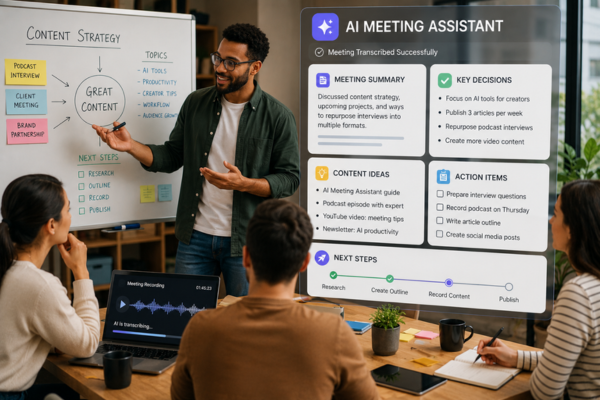
Why Content Creators Need AI Meeting Assistants
Creative work depends on ideas.
The challenge is that ideas rarely appear while sitting quietly in front of a blank document.
They often emerge during conversations.
A client explains a problem that inspires a future article.
A podcast guest shares a story worth expanding into a newsletter.
A teammate suggests a title that later becomes the foundation of an entire video.
These moments happen quickly.
Without a reliable way to capture them, many are lost forever.
An AI meeting assistant helps creators preserve those opportunities automatically.
Instead of dividing attention between listening and writing notes, creators can stay fully engaged in the discussion while AI handles the documentation.
This creates better conversations and better records at the same time.
The benefits become even more valuable when projects involve multiple people.
Marketing teams, freelancers, agencies, educators, and YouTube channels often need to revisit decisions weeks later.
Searching a transcript for a specific keyword is far faster than replaying an hour-long recording.
It also improves collaboration.
Everyone can review the same summary, understand what was decided, and see the next steps without relying on memory or handwritten notes.
For creators who regularly interview experts or clients, AI meeting assistants also reduce the risk of missing important quotes or factual details.
Instead of worrying about documentation, they can focus on asking better questions and building stronger relationships.
Ultimately, an AI meeting assistant doesn’t just save time.
It protects valuable information that can later become articles, videos, podcasts, newsletters, social media posts, or entirely new creative projects.
Meetings Are More Than Meetings
One common misconception is that AI meeting assistants are designed only for corporate environments.
In reality, content creators use conversations in many different ways throughout their workflow.
For example, a single planning session might produce:
- Ideas for future blog posts.
- YouTube video outlines.
- Podcast episode topics.
- Newsletter content.
- Frequently asked questions.
- Social media posts.
- Client deliverables.
- Editorial calendar updates.
Instead of viewing meetings as isolated events, successful creators treat them as opportunities to generate reusable content.
An AI meeting assistant helps organize that information automatically, making it easier to repurpose discussions across multiple formats.
This approach not only improves productivity but also ensures that valuable insights continue creating value long after the meeting has ended.
How AI Meeting Assistants Work
Although AI meeting assistants seem sophisticated, the process behind them is surprisingly simple.
During a meeting, the software listens to the conversation and converts speech into text using automatic speech recognition technology.
From there, artificial intelligence analyzes the transcript to identify the most important information instead of simply displaying every spoken word.
In just a few moments, the system can generate:
- A complete transcript.
- A concise meeting summary.
- Key decisions.
- Action items.
- Important discussion topics.
- Suggested follow-up tasks.
Some AI meeting assistants can even recognize different speakers, making it easier to review interviews, client calls, or team discussions.
The result is an organized record that creators can search, edit, and reuse without listening to the entire meeting again.
How an AI Meeting Assistant Processes Information
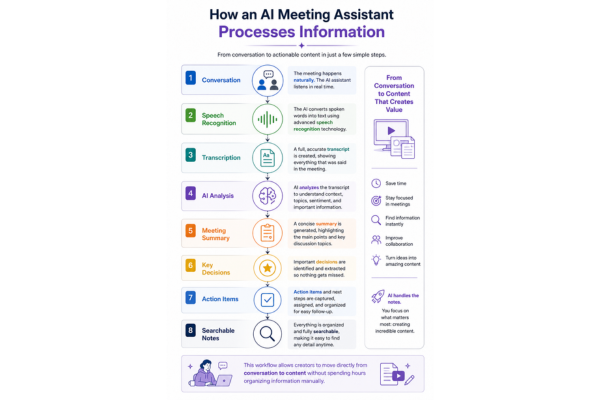
This workflow allows creators to move directly from conversation to content without spending hours organizing information manually.
Benefits of Using an AI Meeting Assistant
The biggest advantage of an AI meeting assistant isn’t simply saving time.
It’s reducing the mental effort required to remember everything that happened during a conversation.
Instead of worrying about writing every detail, creators can stay focused on listening, asking better questions, and contributing meaningful ideas.
The benefits become even more noticeable when projects involve multiple meetings every week.
| Without an AI Meeting Assistant | With an AI Meeting Assistant |
| Manual note-taking | Automatic meeting summaries |
| Missed ideas | Organized key insights |
| Long recordings to review | Searchable transcripts |
| Forgotten action items | Clear next steps |
| Difficult collaboration | Shared meeting documentation |
| Time spent organizing notes | More time creating content |
For many creators, this shift transforms meetings from administrative tasks into valuable sources of future content.
Beyond Meeting Notes: Creative Workflows
Many people associate AI meeting assistants with business meetings.
Content creators use them in much broader ways.
A single recorded conversation can support several stages of the creative process.
For example, a podcast interview may generate:
- A full blog article.
- Several social media posts.
- A newsletter.
- Short video clips.
- Frequently asked questions.
- Future content ideas.
The same happens during client calls.
Instead of writing notes while trying to stay engaged, creators can focus entirely on the conversation.
Afterward, AI organizes everything into structured information that’s easy to revisit.
This approach also helps teams maintain consistency.
Everyone works from the same meeting summary, reducing misunderstandings and making collaboration more efficient.
Real-World Uses for Content Creators
AI meeting assistants have become useful across many creative professions.
Bloggers use them to capture interviews, editorial meetings, and brainstorming sessions.
YouTubers record production meetings, sponsorship discussions, and video planning sessions without worrying about missing important details.
Podcasters automatically generate transcripts that can later become blog posts, show notes, or newsletter content.
Course creators organize coaching sessions, workshops, and webinars while creating searchable learning materials.
Freelancers and agencies document client meetings, track project decisions, and maintain organized communication throughout long-term collaborations.
Rather than replacing existing workflows, AI meeting assistants simplify them.
Every recorded conversation becomes a searchable knowledge base that continues providing value long after the meeting ends.
AI Meeting Assistants Help Teams Think Better
One overlooked advantage of AI meeting assistants is the freedom they create during conversations.
When nobody is responsible for taking detailed notes, participants naturally become more engaged.
Ideas flow more easily.
Questions become more thoughtful.
Discussions feel less interrupted.
Instead of dividing attention between listening and documenting, creators can focus entirely on collaboration while AI handles the organization in the background.
That small shift often leads to more productive meetings and, ultimately, better creative work.
Choosing the Right AI Meeting Assistant
Not every AI meeting assistant offers the same experience.
Some focus on fast transcription, while others prioritize summaries, integrations, or collaboration features.
Instead of choosing the tool with the longest feature list, start by thinking about your own workflow.
Ask yourself a few simple questions:
- Do you mainly record client meetings?
- Do you conduct podcast interviews?
- Do you work alone or with a team?
- Do you need searchable transcripts?
- Will you reuse conversations to create content?
The answers will help you identify which features matter most.
When comparing different AI meeting assistants, pay attention to these areas:
Transcription Accuracy
Even the best AI tools occasionally make mistakes, especially with technical terms, accents, or multiple speakers.
Higher transcription accuracy means less editing later.
Speaker Identification
If your meetings involve several participants, it’s useful when the AI can recognize who said what.
This makes interviews, brainstorming sessions, and client calls much easier to review.
Meeting Summaries
A good summary should highlight the main discussion points instead of simply shortening the transcript.
The goal is to help you understand the conversation in minutes rather than reading every word.
Search and Organization
As your library of meetings grows, finding information quickly becomes essential.
Searchable transcripts, folders, tags, and project organization can save hours over time.
Integrations
Many creators work with calendars, project management apps, cloud storage, or collaboration platforms.
Choosing an AI meeting assistant that integrates smoothly with your existing workflow reduces manual work.
Privacy and Security
Meetings often include sensitive information.
Before using any AI service, review its privacy policy, data retention practices, and security features to ensure your conversations are handled responsibly.
Common Mistakes to Avoid
An AI meeting assistant can dramatically improve productivity, but only when it’s used thoughtfully.
One common mistake is assuming the AI is always correct.
Although modern transcription models are highly accurate, they can still misunderstand names, technical terminology, or overlapping conversations.
Always review important transcripts before publishing or sharing information.
Another mistake is recording meetings without a clear purpose.
If every conversation is saved without organization, you’ll eventually build a large archive that’s difficult to navigate.
Instead, organize recordings by project, client, or content category from the beginning.
Some creators also rely entirely on AI-generated summaries.
While summaries are extremely helpful, they should support your decision-making—not replace it.
A quick review helps confirm that important details haven’t been overlooked.
Finally, avoid treating meetings as isolated events.
The most successful creators revisit previous discussions, connect ideas across projects, and reuse valuable insights whenever possible.
Best Practices for Smarter Meetings
Small habits can make AI meeting assistants even more valuable.
Before each meeting, define its purpose.
Knowing what you want to accomplish helps both participants and AI produce more useful results.
During the conversation, speak clearly and avoid interrupting others whenever possible.
This improves transcription quality and makes summaries easier to understand.
After the meeting, spend a few minutes reviewing the AI-generated notes.
Correct obvious errors, add context where necessary, and highlight the ideas you want to revisit later.
Many creators also benefit from organizing notes into dedicated folders such as:
- Client Projects
- Podcast Interviews
- Content Ideas
- Editorial Planning
- Team Meetings
- Research Sessions
This simple structure makes it much easier to locate information weeks or even months later.
Another effective habit is turning meeting summaries into action.
Instead of letting notes accumulate, convert important ideas into blog outlines, video scripts, content calendars, or production checklists while the discussion is still fresh.
Over time, these small routines create a reliable knowledge base that supports every stage of the creative process.
AI Supports Better Conversations
One of the most valuable benefits of an AI meeting assistant isn’t technical.
It’s human.
When participants know they don’t need to capture every detail manually, conversations become more natural.
People listen more carefully.
They ask better questions.
They share ideas more freely.
Instead of worrying about documentation, everyone can focus on collaboration.
AI quietly handles the organization in the background, allowing creativity and communication to take center stage.
For content creators, that’s often where the best ideas begin.
The Future of AI Meeting Assistants
Artificial intelligence is changing how people work together, and meeting assistants are evolving far beyond simple transcription.
Future AI systems will not only record conversations but also understand context, recognize recurring topics, connect information across multiple meetings, and suggest relevant resources automatically.
Imagine discussing a new YouTube series today and, weeks later, receiving reminders about related ideas from previous brainstorming sessions.
Instead of functioning as isolated tools, AI meeting assistants are becoming long-term knowledge partners.
For content creators, this means less time searching for information and more time turning ideas into valuable content.
As these technologies continue to improve, the real advantage will not come from recording more meetings—it will come from making every conversation easier to understand, organize, and reuse.
Creators who build organized knowledge today will be better prepared for increasingly collaborative AI workflows in the future.
To better understand how generative AI analyzes and organizes information, Google’s Introduction to Generative AI provides an accessible overview of the technology behind many modern AI assistants.
Key Takeaways
- AI meeting assistants automatically capture conversations and organize important information.
- They combine transcription, summaries, action items, and searchable notes in one workflow.
- Content creators can use them for much more than business meetings, including interviews, brainstorming sessions, editorial planning, webinars, podcasts, and client discussions.
- Organized meeting records make it easier to create blog posts, videos, newsletters, and social media content.
- Reviewing AI-generated notes and adding personal context leads to more reliable results.
- AI works best as a productivity partner that supports human creativity rather than replacing it.
Frequently Asked Questions
What is an AI meeting assistant?
An AI meeting assistant is software that records conversations, creates transcripts, summarizes discussions, identifies action items, and organizes meeting information automatically. It helps users review important conversations without taking manual notes.
How is an AI meeting assistant different from an AI note taker?
An AI note taker primarily focuses on capturing and organizing information. An AI meeting assistant usually includes additional features such as speaker recognition, automatic summaries, meeting insights, action items, and integrations with collaboration platforms.
Can content creators benefit from AI meeting assistants?
Absolutely. Bloggers, YouTubers, podcasters, educators, freelancers, agencies, and course creators can use AI meeting assistants to organize interviews, brainstorming sessions, editorial meetings, client calls, and research discussions more efficiently.
Are AI meeting assistants accurate?
Modern AI meeting assistants are highly accurate, especially when audio quality is good. However, creators should always review transcripts and summaries before using them in professional or published content.
Every Conversation Can Become Your Next Great Idea
Many creators think of meetings as administrative tasks that interrupt creative work.
In reality, conversations are often where the best ideas begin.
A client asks an unexpected question.
A teammate suggests a new angle.
An interview reveals a story worth sharing.
A brainstorming session uncovers the outline for an entire content series.
Without an organized system, many of these opportunities disappear as soon as the meeting ends.
An AI meeting assistant helps preserve those moments, making them easy to revisit whenever inspiration is needed.
Technology continues to evolve, but successful content creation still depends on curiosity, communication, and thoughtful decision-making.
Artificial intelligence can capture conversations, organize information, and highlight patterns.
Only you can decide which ideas deserve to become meaningful content.
At ForgeCreatorAI, we believe AI delivers its greatest value when it removes repetitive work and gives creators more time to think, collaborate, and create.
The goal isn’t to have more meetings.
It’s to make every conversation count.

ForgeCreatorAI Team writes about AI tools, content creation, digital workflows, and productivity systems for modern creators. Our goal is to simplify AI technology and help creators work smarter through practical tools and automation.