
Great ideas rarely appear when you’re sitting in front of your computer, ready to create content.
They often arrive while you’re watching a webinar, recording a podcast, talking to a client, attending a virtual meeting, or even taking a walk. The challenge isn’t having ideas—it’s remembering them later.
An AI note taker helps content creators capture conversations, organize information, and turn scattered thoughts into useful notes without interrupting the creative process.
Instead of worrying about writing everything down, creators can stay focused on the discussion, interview, or brainstorming session while artificial intelligence automatically records key points, generates summaries, and highlights important action items.
For creators who publish consistently, that can make a significant difference.
Whether you’re producing YouTube videos, writing blog posts, hosting podcasts, creating online courses, or managing client projects, an AI note taker can become one of the most valuable productivity tools in your workflow.
The goal isn’t simply to replace handwritten notes.
It’s to ensure that valuable ideas don’t disappear before they become valuable content.
What Is an AI Note Taker?
An AI note taker is a productivity tool that uses artificial intelligence to capture spoken conversations, convert them into written notes, and organize important information automatically.
Unlike traditional note-taking apps, modern AI note takers do much more than store text.
They can listen to conversations, recognize different speakers, identify key topics, generate summaries, extract action items, and make information easier to search later.
For content creators, this means less time spent writing notes during meetings and more time focusing on ideas.
Imagine recording a one-hour interview for your podcast.
Instead of replaying the entire recording several times to find an important quote, an AI note taker can provide a searchable transcript, highlight the main discussion points, and even suggest a concise summary within minutes.
The technology works quietly in the background while you concentrate on the conversation itself.
Rather than replacing creativity, it helps organize the information that fuels it.
Why Content Creators Lose Valuable Ideas
Every creator has experienced the frustration of forgetting a great idea.
A headline comes to mind while driving.
A client suggests an interesting topic during a meeting.
A guest shares an insightful quote during an interview.
A solution to a difficult problem appears halfway through a podcast recording.
At the time, each idea feels unforgettable.
A few hours later, it’s gone.
Creative work generates an enormous amount of information every day.
Meetings.
Research.
Voice memos.
Brainstorming sessions.
Course lessons.
Client feedback.
Podcast recordings.
Webinars.
Live streams.
Trying to capture all of this manually often leads to incomplete notes, missed details, and hours spent searching through notebooks or replaying recordings.
As content production increases, keeping everything organized becomes even more challenging.
Many creators don’t lose ideas because they lack creativity.
They lose ideas because they don’t have a reliable system for capturing them.
An AI note taker helps solve that problem by collecting information automatically, organizing it into structured notes, and making it easy to retrieve whenever it’s needed.
Why Traditional Note-Taking No Longer Fits Modern Content Creation
For many years, handwritten notebooks and simple note-taking apps were enough.
Today’s creative workflow looks very different.
A single project may involve video calls, research documents, podcast recordings, collaborative brainstorming sessions, emails, and voice messages spread across multiple platforms.
Trying to keep track of everything manually quickly becomes overwhelming.
Many creators find themselves switching constantly between listening, writing, and participating in conversations.
Every moment spent taking notes is a moment not fully engaged with the discussion.
That’s one reason AI note takers have become increasingly popular.
Instead of forcing creators to divide their attention, they automate the repetitive task of documenting conversations while allowing people to stay present and focused.
The result isn’t just better notes.
It’s better conversations.
The Difference Between Taking Notes and Capturing Knowledge
Writing notes is only the first step.
The real value comes from being able to use those notes later.
Think about how often creators ask questions like:
- Where did I write that idea?
- Which meeting discussed that project?
- What did my guest say about this topic?
- Which episode included that quote?
- What tasks did we agree to complete?
Finding those answers manually can take longer than the meeting itself.
An AI note taker transforms raw conversations into organized knowledge.
Instead of creating another document that sits forgotten in a folder, it builds a searchable record of your creative process.
Organizing information is only one part of the creative process. Our guide on AI Research Tools for Writers explores how creators gather reliable information before transforming it into high-quality content.
Weeks or even months later, you can quickly locate important discussions, revisit key decisions, or recover ideas that might otherwise have been lost.
For creators producing content consistently, that kind of organization becomes a major advantage.
Why AI Note Takers Are Becoming Essential for Creators
Content creation has never moved faster.
Many creators now publish across several platforms at the same time.
A single idea can become:
- A YouTube video.
- A blog article.
- A newsletter.
- Several social media posts.
- A podcast episode.
- A short-form video.
- A presentation.
Managing that volume of information without an organized system is increasingly difficult.
An AI note taker doesn’t generate creativity on your behalf.
Instead, it helps preserve the ideas you already have.
By automatically documenting conversations, organizing research, and highlighting important information, it reduces administrative work and gives creators more time to focus on planning, producing, and publishing meaningful content.
In many ways, it’s less about taking notes and more about protecting your best ideas before they’re forgotten.
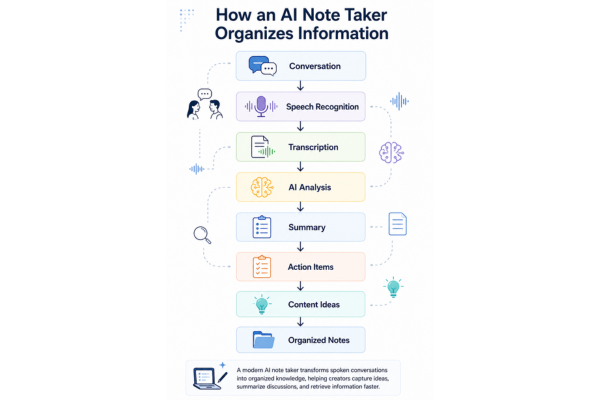
How AI Note Takers Work
At first glance, an AI note taker may seem almost magical.
You start a meeting, an interview, or a brainstorming session, and by the end, you already have organized notes, a searchable transcript, and a summary of the most important points.
Behind the scenes, however, the process follows a logical sequence.
It begins by capturing spoken conversations.
Artificial intelligence then converts speech into text, analyzes the content, identifies the most relevant information, and organizes everything into a structured format that is easy to review later.
A simplified workflow looks like this:
Conversation
↓
Speech Recognition
↓
Transcription
↓
AI Analysis
↓
Summary
↓
Action Items
↓
Content Ideas
↓
Organized Notes
Although the technology is sophisticated, the experience for the user is simple.
Instead of taking notes while trying to stay engaged in a discussion, creators can focus entirely on the conversation, knowing that important details are being captured automatically.
Many AI note takers also recognize different speakers, identify recurring topics, and generate summaries that are much easier to review than a full transcript.
The result is less time spent searching through recordings and more time creating content.
Creators interested in learning more about the technology behind speech recognition and generative AI can explore Google AI’s Introduction to Generative AI, which explains how modern AI systems process and organize information.
Benefits of Using an AI Note Taker
The biggest advantage of an AI note taker isn’t simply creating transcripts.
It’s reducing the amount of manual work involved in organizing information.
Instead of juggling notebooks, documents, screenshots, and voice recordings, creators can access everything in one searchable place.
Some of the most valuable benefits include:
| Without an AI Note Taker | With an AI Note Taker |
| Manual note-taking | Automatic note capture |
| Missed ideas | Organized information |
| Hours reviewing recordings | Instant summaries |
| Difficult to find information | Searchable notes |
| Repeated listening | Key points identified automatically |
| Scattered documents | Centralized knowledge |
For creators who publish regularly, these small improvements add up quickly.
Saving just fifteen minutes after every meeting or interview can translate into several extra hours each month—time that can be invested in writing, editing, or planning future content.
Perhaps even more important, AI note takers reduce the mental effort required to remember everything.
Instead of worrying about missing an important detail, creators can stay fully engaged in the conversation.
Common Ways Content Creators Use AI Note Takers
Although many people associate AI note takers with business meetings, content creators use them in far more creative ways.
The technology can support almost every stage of the content creation process.
Bloggers
Writers often interview experts, collect research, attend webinars, and brainstorm article ideas.
An AI note taker keeps those conversations organized and makes it much easier to revisit useful information when writing.
YouTubers
Video creators frequently plan scripts through brainstorming sessions or discuss ideas with collaborators.
Automatic summaries help transform conversations into structured video outlines without reviewing hours of recordings.
Podcasters
Interviews generate valuable insights, memorable quotes, and unexpected ideas.
Instead of manually marking timestamps, creators can quickly search transcripts and locate important moments for editing or creating show notes.
Online Course Creators
Educational creators often record planning meetings, lesson reviews, and student feedback sessions.
Organized notes help improve future lessons while keeping important suggestions accessible.
Freelancers and Agencies
Creative professionals regularly meet with clients to discuss projects, revisions, and deadlines.
AI-generated summaries reduce misunderstandings and make it easier to track agreed actions.
Coaches and Consultants
Client conversations often include recurring questions and valuable teaching moments.
Capturing those discussions allows creators to build future articles, videos, newsletters, or training materials based on real audience needs.
AI Note Takers Help Beyond Meetings
One of the biggest misconceptions about AI note takers is that they exist only for virtual meetings.
In reality, creators use them throughout the day, even when no meeting is taking place.
For example, you might record a quick voice memo after reading an interesting article.
You might capture ideas while walking.
You might summarize a podcast episode before turning it into a newsletter.
You might organize research collected from several different sources before writing a blog post.
In each case, the AI isn’t replacing your thinking.
It’s helping you preserve your ideas while reducing the time spent organizing information manually.
That’s what makes AI note takers so valuable for modern creators.
They’re not simply meeting assistants.
They’re knowledge management tools designed to support creative work from the first idea to the final published piece.
How to Choose the Right AI Note Taker
Not every AI note taker is built for the same purpose.
Some focus on business meetings.
Others prioritize transcription accuracy.
Some integrate with video conferencing platforms, while others are designed for organizing personal knowledge.
Instead of asking, “Which AI note taker is the best?”, a better question is:
Which one fits the way you create content?
Before choosing a tool, consider these important factors.
Accuracy
A note taker is only useful if it captures conversations correctly.
Small transcription mistakes can completely change the meaning of an interview, meeting, or brainstorming session.
Look for tools that consistently recognize different speakers, punctuation, and technical terms.
Language Support
Many creators work with international audiences.
If you publish content in more than one language, check whether the platform supports accurate transcription and summaries for the languages you use most often.
Organization Features
Capturing information is only half the job.
The real value comes from finding it later.
Folders, tags, searchable transcripts, and project organization can save countless hours when you’re working on multiple pieces of content.
Export Options
Your notes shouldn’t stay trapped inside one application.
A good AI note taker should allow you to export transcripts, summaries, or action items so they can be used in writing tools, project management software, or content planning systems.
Privacy and Security
Creators often discuss client projects, unpublished ideas, or sensitive business information.
Before uploading recordings, understand how the platform stores your data and what privacy controls are available.
Workflow Integration
Think about the tools you already use every day.
An AI note taker becomes far more valuable when it fits naturally into your existing workflow instead of creating additional steps.
The best solution isn’t necessarily the one with the longest feature list.
It’s the one that helps you create better content with less effort.
Common Mistakes When Using AI Note Takers
Artificial intelligence can organize information remarkably well.
Still, it’s not perfect.
Many creators reduce its value simply because they rely on it the wrong way.
Here are some of the most common mistakes.
Trusting Every Word Automatically
AI-generated transcripts are often highly accurate, but they can still misunderstand names, technical terms, or unclear audio.
Always review important notes before publishing or sharing them.
Recording Poor Audio
Even the best AI struggles when the original recording contains background noise, overlapping conversations, or weak microphones.
Better audio almost always leads to better notes.
Forgetting to Add Context
A transcript records what people said.
It doesn’t always explain why something was important.
After reviewing your notes, add short comments while the conversation is still fresh in your mind.
Future you will appreciate it.
Letting Notes Pile Up
Capturing information without organizing it creates a different problem.
Instead of losing ideas, you end up with hundreds of files you’ll never revisit.
Create a simple system for sorting notes by project, client, topic, or publication date.
Expecting AI to Think for You
An AI note taker can summarize discussions.
It cannot replace your judgment.
Important decisions, creative direction, and final conclusions should always come from you.
Think of AI as an assistant—not the decision-maker.
Best Practices for Smarter Note-Taking
Getting better results doesn’t require more technology.
It requires better habits.
The following practices can help you turn AI-generated notes into valuable creative assets.
Review Notes Soon After Each Session
The sooner you review your notes, the easier it is to remember important context that may not appear in the transcript.
A quick five-minute review can prevent confusion later.
Highlight Action Items
Separate information from action.
Mark the tasks that require follow-up so they don’t get buried inside long transcripts.
Organize by Project
Instead of storing every meeting in one folder, group notes according to the content you’re creating.
For example:
- YouTube Videos
- Blog Articles
- Podcast Episodes
- Client Projects
- Online Courses
A simple structure makes future searches much faster.
Add Personal Insights
AI captures conversations.
Only you can capture inspiration.
After reading the summary, write one or two personal observations about how the information could become future content.
These small notes often become the starting point for your next article or video.
Once your ideas are organized, learning how to communicate them effectively with AI becomes equally important. Our article on Why Prompt Quality Matters More Than the AI Tool You Choose explains how better prompts lead to better creative results.
Reuse Your Notes Across Different Formats
One conversation can generate much more than meeting minutes.
A single transcript may become:
- A blog post.
- A YouTube script.
- A podcast outline.
- A newsletter.
- Multiple social media posts.
- A content calendar.
This is where AI note takers become productivity tools instead of simple transcription software.
They help creators transform conversations into publishable content across multiple platforms.
Organizing ideas is only the first step. Our guide to AI Content Planning for Creators shows how structured notes can become a complete publishing workflow across multiple platforms.
From Information to Content
The most successful creators don’t collect information simply to store it.
They collect information to use it.
An AI note taker makes that process easier by reducing the time spent documenting conversations and increasing the time available for writing, recording, editing, and publishing.
When combined with a clear content strategy, organized notes become more than archived conversations.
They become a library of future ideas waiting to be developed.
Whether you’re planning your next YouTube video, outlining a course, writing a blog post, or preparing a podcast interview, having organized knowledge available can dramatically improve both speed and consistency.
For many creators, the greatest benefit of an AI note taker isn’t automation.
It’s never losing a valuable idea again.
The Future of AI Note Taking
Artificial intelligence continues to evolve at an impressive pace, and note-taking technology is evolving with it.
What started as simple speech-to-text software has become a powerful productivity system capable of organizing conversations, identifying key ideas, generating summaries, and helping creators manage increasingly complex workflows.
Future AI note takers will likely become even more context-aware.
Instead of simply recording what was said, they may understand project goals, recognize recurring topics across multiple conversations, suggest content opportunities, and automatically connect related ideas from different meetings.
Imagine discussing a video concept during a client call and having your AI note taker instantly connect it with research from a previous interview, a blog outline you started last month, and a list of future content ideas.
That level of organization could dramatically reduce the time creators spend searching for information and allow them to focus more on creating.
Still, no matter how advanced these systems become, one thing is unlikely to change.
Artificial intelligence can organize information.
People create meaning from it.
The most valuable content will always come from human experience, curiosity, creativity, and critical thinking.
AI simply makes it easier to preserve those ideas before they disappear.
Key Takeaways
- AI note takers automatically capture conversations and organize information into searchable notes.
- They help creators stay focused instead of dividing attention between listening and writing.
- Organized notes can become blog posts, videos, podcasts, newsletters, and future content ideas.
- Choosing the right tool depends on your workflow, not simply on the number of available features.
- Reviewing, organizing, and adding personal insights makes AI-generated notes far more valuable.
- Artificial intelligence improves productivity, but human creativity remains the foundation of meaningful content.
FAQ
What is an AI note taker?
An AI note taker is a tool that automatically records conversations, converts speech into text, generates summaries, identifies key points, and organizes notes so they are easier to review and search later.
How is an AI note taker different from a transcription tool?
A transcription tool mainly converts speech into text.
An AI note taker goes further by analyzing conversations, creating summaries, identifying action items, organizing information, and helping users quickly find important insights without reading an entire transcript.
Can content creators benefit from AI note takers?
Absolutely.
Bloggers, YouTubers, podcasters, educators, freelancers, and course creators often manage large amounts of information every day.
An AI note taker helps capture ideas, organize research, summarize interviews, and reduce the time spent reviewing recordings.
Do AI note takers replace manual note-taking completely?
Not necessarily.
They significantly reduce manual work, but reviewing important conversations and adding your own observations remains a valuable part of the creative process.
The best results usually come from combining AI-generated notes with human judgment and experience.
Every Great Idea Deserves to Be Remembered
Some of the best ideas never arrive while you’re staring at a blank page.
They appear during conversations, interviews, brainstorming sessions, client meetings, or unexpected moments throughout the day.
The challenge isn’t finding inspiration.
It’s capturing it before it disappears.
An AI note taker helps solve that problem by creating a reliable system for collecting, organizing, and revisiting the information that fuels creative work.
For content creators, that means spending less time searching through recordings and scattered notes, and more time writing, filming, editing, and publishing.
As AI continues to improve, the technology behind note-taking will become faster, smarter, and more connected to the way creators work.
But the ideas themselves will still come from people.
The questions you ask.
The stories you tell.
The experiences you share.
Those are the elements that no software can replace.
At ForgeCreatorAI, we believe artificial intelligence delivers its greatest value when it supports human creativity rather than trying to replace it.
An AI note taker is more than a productivity tool.
It’s a way to protect your best ideas, organize your creative process, and make sure today’s conversation can become tomorrow’s content.
ForgeCreatorAI Team writes about AI tools, content creation, digital workflows, and productivity systems for modern creators. Our goal is to simplify AI technology and help creators work smarter through practical tools and automation.