
An AI rewriter can dramatically speed up the content creation process without sacrificing quality. Creating great content often takes more than inspiration. Editing, improving clarity, adjusting tone, and making ideas easier to understand can take just as much time as writing the first draft. By refining existing text instead of starting over, an AI rewriter helps content creators produce clearer, more engaging, and better-structured content while preserving the original message.
Whether you’re updating an old blog post, refining a YouTube script, rewriting a newsletter, or adapting social media content for different platforms, AI rewriting tools can significantly reduce editing time. Instead of starting from scratch, creators can improve what they already have and focus more on creativity, storytelling, and audience engagement.
Many creators also combine AI rewriters with our guide on AI Research Tools to speed up content creation from research to publication.
Modern AI rewriters go far beyond correcting grammar. They can simplify complex sentences, adjust writing style, improve readability, eliminate repetition, and even optimize content for different audiences. Used correctly, they become valuable writing assistants that help creators publish consistently without sacrificing quality.
Many modern AI rewriters also help creators maintain consistency across blogs, newsletters, video scripts, and social media content.
In this guide, you’ll learn how AI rewriters work, why they’re becoming essential for modern content creators, and how to use them responsibly to produce polished, original content faster.
What Is an AI Rewriter?
An AI rewriter is a writing tool that analyzes existing text and generates a rewritten version while preserving the original meaning. Using natural language processing and large language models, these tools recognize context, sentence structure, and writing style to create smoother, clearer, or more engaging alternatives.
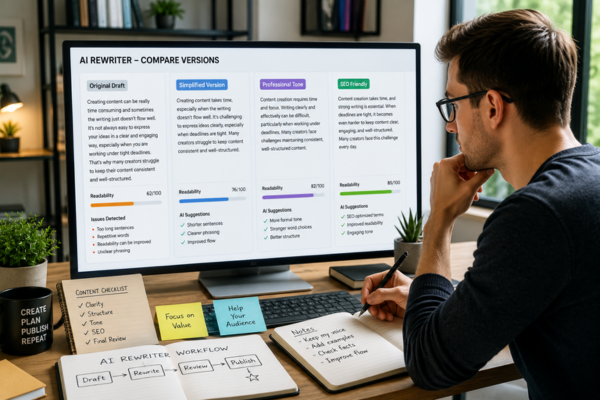
Unlike traditional grammar checkers, AI rewriters don’t simply correct mistakes. They can completely restructure paragraphs, improve sentence flow, change the tone of writing, simplify technical explanations, or make content more suitable for a specific audience.
For content creators, this means less time spent manually editing every paragraph and more time creating valuable content. A rough first draft can quickly become a polished article, video script, product description, or email with only minor human adjustments.
However, the best results still come from collaboration. AI provides suggestions, while creators add expertise, personality, and fact-checking to ensure the final content remains accurate, authentic, and aligned with their own voice.
Why Content Creators Use AI Rewriters
Every creator eventually faces the same challenge: the first draft is rarely the final version.
A blog article may contain repetitive phrases. A YouTube script might sound unnatural when spoken aloud. A newsletter could feel too formal, while a LinkedIn post may need a more professional tone than the original draft.
An AI rewriter helps solve these common editing challenges by offering alternative ways to express the same ideas more effectively.
Content creators frequently use AI rewriters to:
- Improve readability without changing the message.
- Rewrite paragraphs that sound repetitive.
- Adapt content for different platforms.
- Simplify complex explanations for broader audiences.
- Refresh older articles with updated wording.
- Create multiple variations of headlines and introductions.
- Save time during the editing process.
Instead of replacing creativity, AI allows creators to spend less time refining individual sentences and more time developing ideas that genuinely connect with their audience.
Common Ways Creators Use AI Rewriters
An AI rewriter can support almost every stage of the content creation process. Rather than generating entirely new material, it helps creators improve, adapt, and refine existing content for different audiences and platforms.
One of the most common uses is updating older articles. Instead of rewriting an entire blog post manually, creators can refresh outdated sections, improve readability, and modernize the writing style while keeping valuable information intact.
Video creators also benefit from AI rewriting tools. A script that reads well on paper may sound unnatural when spoken aloud. AI can suggest more conversational phrasing, making videos feel more authentic and engaging.
This workflow becomes even faster when creators first convert spoken ideas into text using AI Transcription before rewriting and polishing the final script.
Many creators also repurpose content across multiple platforms. A long-form article can be rewritten into a LinkedIn post, an email newsletter, several X (formerly Twitter) posts, or a concise Facebook update without repeating the exact same wording.
Other common applications include:
- Improving article introductions.
- Simplifying technical explanations.
- Rewriting product descriptions.
- Refreshing email campaigns.
- Creating alternative social media captions.
- Generating multiple headline variations.
- Adapting writing for different audiences.
- Updating evergreen content without starting over.
When used thoughtfully, AI rewriting allows creators to maximize the value of every piece of content they produce.
Benefits of Using an AI Rewriter for Content Creators
For content creators, time is often the most limited resource. Writing, editing, publishing, and promoting content all compete for attention, making efficiency essential.
An AI rewriter helps reduce editing time while improving the overall quality of written content.
Some of the biggest advantages include:
Faster Editing
Instead of manually rewriting multiple paragraphs, creators receive alternative versions within seconds. This speeds up the revision process while leaving full creative control in the hands of the author.
Improved Readability
AI often identifies overly complex sentences and replaces them with clearer, more natural alternatives that are easier for readers to understand.
Consistent Tone
Whether writing for a professional blog, a casual newsletter, or a YouTube audience, AI can help maintain a consistent tone throughout the entire piece.
Better Content Repurposing
Creators no longer need to write every version of their content from scratch. Existing material can be adapted for different platforms while maintaining the core message.
Reduced Writer Fatigue
After spending hours writing, it becomes difficult to notice repetitive words or awkward phrasing. AI offers a fresh perspective, making the editing process less exhausting.
Although these benefits are significant, the best results come when creators review every suggestion instead of accepting automated changes without evaluation.
Best Practices for Better Results
Like any creative tool, an AI rewriter performs best when guided by clear human input.
Following a few simple practices helps maintain originality, accuracy, and trust with readers.
Start with a Strong Draft
AI improves existing writing more effectively than it creates quality from incomplete ideas. A clear first draft usually leads to much better rewritten versions.
Review Every Suggestion
Not every recommendation will perfectly match your intended meaning. Always read the rewritten text carefully before publishing.
Keep Your Personal Voice
Readers connect with authenticity. Adjust AI suggestions so they continue reflecting your own style, experience, and personality.
Verify Facts and Statistics
AI rewriting tools may improve wording, but creators remain responsible for ensuring that all information is accurate and current.
Focus on Helping Readers
The goal should never be to rewrite content solely for search engines. Instead, use AI to make information clearer, more useful, and more enjoyable to read.
When creators combine human expertise with AI assistance, they produce content that is both efficient and genuinely valuable.
Common Mistakes to Avoid When Using an AI Rewriter
AI rewriters can dramatically improve productivity, but they aren’t designed to replace human judgment. Creators who rely entirely on automated suggestions often publish content that feels generic, inconsistent, or even inaccurate.
Avoiding a few common mistakes helps ensure that AI remains a valuable assistant rather than becoming a limitation.
Publishing Without Reviewing
One of the biggest mistakes is accepting every AI suggestion without reading the final text.
While AI can improve sentence structure and readability, it may occasionally misunderstand context or change the intended meaning. A quick human review ensures the final version remains accurate and natural.
Rewriting Only for Search Engines
Some creators repeatedly rewrite text to insert more keywords, hoping to improve rankings.
Instead, focus on creating content that genuinely helps readers. Search engines increasingly reward helpful, original, and people-first content over pages written primarily for algorithms.
Losing Your Brand Voice
Every creator develops a unique writing style over time.
If every paragraph is completely rewritten by AI, the content may lose the personality that makes it recognizable. Use AI suggestions as inspiration while preserving your own tone and perspective.
Ignoring Fact-Checking
Although AI can improve wording, it doesn’t guarantee factual accuracy.
Always verify statistics, dates, product information, quotations, and technical explanations before publishing.
Using AI to Rewrite Copyrighted Content
AI rewriters should help improve your own writing—not disguise someone else’s work.
Creating original content, citing reliable sources, and respecting copyright remain essential for building long-term credibility and trust.
Choosing the Right AI Rewriter
Not every AI rewriter is designed for the same type of creator.
Some tools specialize in academic writing, while others focus on marketing copy, blog articles, social media posts, or professional communication.
When evaluating an AI rewriter, consider features such as:
- Natural and fluent rewriting.
- Multiple tone options.
- Grammar and readability improvements.
- Support for long-form content.
- Multilingual capabilities.
- Easy editing and revision workflow.
- Integration with writing platforms.
- Data privacy and security.
Instead of looking for a tool that rewrites the most aggressively, creators should prioritize one that helps preserve meaning while making content clearer and easier to read.
The best AI rewriter is the one that supports your creative workflow rather than replacing your own ideas.
If you’re interested in learning more about responsible AI writing practices, Google’s guidance on creating helpful, people-first content provides useful recommendations for creators.
Frequently Asked Questions
Can an AI rewriter replace human writers?
No. AI rewriters assist with editing, improving clarity, and generating alternative wording, but creativity, expertise, storytelling, and critical thinking still depend on the creator.
Does using an AI rewriter improve SEO?
Indirectly, yes. A well-edited article is often easier to read and more engaging for visitors. However, strong SEO also depends on original content, search intent, quality information, and a good user experience.
Well-structured, readable content also increases the likelihood that visitors stay longer on your page and engage with your content.
Is rewritten content considered plagiarism?
Not when used correctly. AI rewriting should improve your own work or content you have permission to modify. Publishing someone else’s ideas without authorization or proper attribution remains unethical and may violate copyright.
Should I accept every AI suggestion?
No. Always review the rewritten version carefully. Human editing ensures that the final content remains accurate, authentic, and aligned with your personal writing style.
Keep Improving Every Draft
Writing great content rarely happens in a single attempt. The first draft captures ideas, but thoughtful editing transforms those ideas into content that is clearer, more engaging, and easier to understand.
An AI rewriter helps creators accelerate that process by improving readability, refining tone, and adapting content for different audiences without requiring them to start from scratch. Whether you’re polishing a blog post, updating a YouTube script, rewriting a newsletter, or preparing social media content, AI can reduce editing time while allowing you to stay focused on creativity.
The most successful creators don’t use AI to replace their expertise—they use it to enhance it. By combining human judgment with intelligent writing assistance, it’s possible to publish consistently, maintain quality, and communicate ideas more effectively across every platform.
As AI writing technology continues to evolve, creators who learn how to use these tools responsibly will be better prepared to produce valuable content faster while preserving the originality that builds trust with their audience.

ForgeCreatorAI Team writes about AI tools, content creation, digital workflows, and productivity systems for modern creators. Our goal is to simplify AI technology and help creators work smarter through practical tools and automation.