
Best free AI script writers for faceless history YouTube channels help creators organize research, build timelines, write scripts faster, and improve storytelling workflows.
Yet they can spend several hours researching, organizing information, checking facts, building timelines, and writing scripts before a single video is published.
From the viewer’s perspective, the process looks simple.
A narrator explains an ancient civilization.
A documentary-style video explores a famous battle.
A timeline reveals the rise and fall of an empire.
Everything appears smooth and effortless.
What viewers rarely see is the amount of preparation happening behind the scenes.
For many history creators, script writing becomes one of the most time-consuming parts of the entire workflow.
This is one reason AI writing tools are becoming increasingly common among faceless YouTube channels.
The goal is rarely to replace research or storytelling.
Instead, these tools help creators organize information more efficiently and reduce the amount of time spent turning research into structured scripts.
Why History Channels Require More Research Than Most Creators Expect
Many content niches allow creators to publish quickly.
History content usually works differently.
A creator covering historical topics often needs to verify information from multiple sources, compare dates, organize events chronologically, and simplify complex subjects into stories that viewers can easily follow.
A single video may involve researching:
- Historical events
- Important figures
- Timelines
- Geographic context
- Cultural background
- Academic sources
- Supporting details
As channels grow, creators often find themselves managing dozens of unfinished ideas and research projects simultaneously.
Without organization, valuable information can become difficult to locate when it is finally time to write.
The Hidden Work Behind Faceless History Videos
Many beginners assume that editing is the hardest part of creating history content.
In reality, script development often requires significantly more effort.
A creator may spend days researching a topic only to struggle when turning scattered notes into a compelling narrative.
The challenge is rarely finding information.
The challenge is transforming information into a story.
History viewers do not simply want dates and facts.
They want context.
They want explanations.
They want to understand why events mattered and how they influenced what happened next.
Building that structure manually can become overwhelming, especially for creators publishing regularly.
Many creators also use AI systems to organize research notes and content pipelines more efficiently, similar to the workflow strategies discussed in our article about how YouTube script writers are using AI to stay organized.
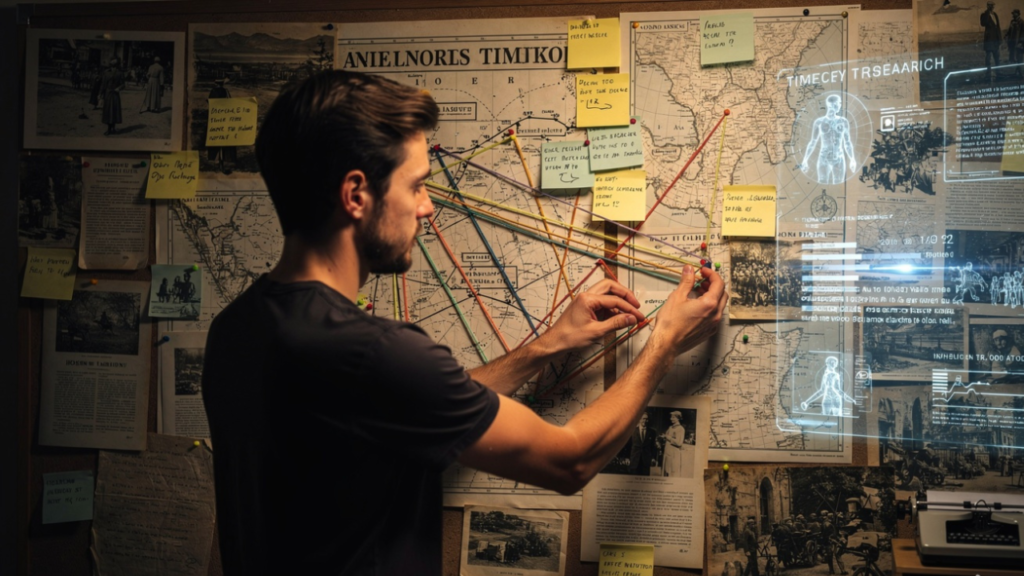
How Free AI Script Writers for Faceless History YouTube Channels Save Time
Most successful creators are not using AI to generate entire videos automatically.
Instead, they use AI throughout different stages of the writing process.
Many history creators rely on AI to:
- Organize research notes
- Generate script outlines
- Build timelines
- Summarize complex information
- Brainstorm video angles
- Improve readability
- Simplify complicated explanations
- Expand rough ideas into structured drafts
In this role, AI functions more like a research assistant than a replacement writer.
The creator still controls the narrative, interpretation, and final script.

What Makes a Good AI Tool for History Content
Not every AI writing platform performs equally well for historical topics.
The best tools usually help creators organize information clearly while preserving accuracy and readability.
For history channels, useful features often include:
- Long-form content support
- Research assistance
- Outline generation
- Summarization tools
- Context retention
- Draft organization
Creators should remember that AI can help structure information, but historical accuracy still requires human verification.
Facts should always be reviewed before publication.
Best Free AI Script Writers for Faceless History Channels
Choosing the right AI writing tool depends on what part of the content creation process you need help with. Some tools are better suited for brainstorming and outlining, while others are more useful for organizing large amounts of research or managing a content workflow.
For faceless history YouTube channels, the most useful approach is often to combine AI assistance with careful research and human review.
Here are five tools that can support different stages of the history content creation process.
ChatGPT
ChatGPT remains one of the most versatile options for history creators.
Many YouTubers use it to brainstorm video ideas, create outlines, organize research notes, improve drafts, and develop narration scripts.
Best for: Brainstorming, outlines, and script development.
Main strength: Flexibility across multiple stages of the writing process.
How history creators can use it: A creator might begin with a historical topic, ask for a structured timeline, develop an outline from that timeline, and then turn the outline into a documentary-style script.
As with any AI-assisted workflow, creators should review important historical information before publishing.
Claude
Claude can be particularly useful when creators need to work with large amounts of research material.
History videos often require extensive notes, articles, timelines, and background information. Organizing this material manually can take considerable time.
Best for: Working with detailed research and organizing large amounts of information.
Main strength: Summarizing and structuring complex material.
How history creators can use it: A creator could use AI assistance to summarize research notes, identify recurring themes, organize historical events chronologically, and create a structured foundation for a documentary script.
The final narrative should still be reviewed by the creator to ensure that important context has not been lost during the summarization process.
Gemini
Gemini can be useful for creators researching broad historical subjects and developing structured explanations.
History topics often involve multiple periods, locations, people, and interconnected events. Organizing these elements into a clear narrative can be challenging.
Best for: Exploring broad topics and organizing complex historical subjects.
Main strength: Helping creators structure information and develop explanations.
How history creators can use it: A creator might use AI assistance to explore the major events surrounding a historical period, organize them into a timeline, and identify potential angles for a future video.
As with other AI tools, creators should independently verify historical claims before including them in a published video.
Perplexity
Perplexity has become popular among creators who want research assistance alongside AI-generated explanations.
For history channels, the research stage is particularly important because scripts often depend on dates, events, historical figures, and supporting evidence.
Best for: Research assistance and discovering potential sources.
Main strength: Helping creators explore topics and locate information that may support further research.
How history creators can use it: A creator can begin researching a historical event, identify relevant sources, collect background information, and use the results as a starting point for developing a video script.
Creators should still evaluate the original sources themselves rather than relying exclusively on AI-generated summaries or references.
Notion AI
Notion AI is different from the other tools on this list because its value extends beyond script writing.
For creators producing videos consistently, managing research and content ideas can become just as important as writing the script itself.
Best for: Organizing research, content ideas, and production workflows.
Main strength: Combining AI assistance with a broader workspace for notes and content planning.
How history creators can use it: A creator could maintain separate collections for future video ideas, historical timelines, research summaries, source materials, draft outlines, and completed scripts.
This type of organization can make it easier to return to unfinished projects and maintain a consistent publishing workflow.
Which AI Script Writer Is Best for History YouTube Channels?
There is no single AI tool that is perfect for every history creator.
The best choice depends on the creator’s workflow and the stage of production where assistance is needed.
Someone focused on brainstorming and developing scripts may prefer a flexible writing assistant. A creator working with extensive research may prioritize tools that help organize large amounts of information. Others may benefit more from research assistance or a structured content management system.
The most effective workflow may therefore involve using different tools for different tasks rather than relying on a single AI platform.
Regardless of the tool selected, historical accuracy should remain a priority. AI can help creators organize information and speed up parts of the writing process, but human judgment is still essential when turning research into trustworthy historical storytelling.
AI Script Writer Comparison for History YouTube Channels
The following comparison can help creators identify which type of AI tool may fit their workflow best:
| AI Tool | Best For | Main Strength | Useful for History Creators |
|---|---|---|---|
| ChatGPT | Brainstorming and script development | Flexible writing assistance | Creating outlines, developing narratives, and improving drafts |
| Claude | Detailed research materials | Organizing and summarizing complex information | Structuring research notes and preparing documentary scripts |
| Gemini | Broad historical topics | Developing structured explanations | Exploring historical subjects and organizing timelines |
| Perplexity | Research assistance | Discovering information and potential sources | Exploring historical events and supporting further research |
| Notion AI | Content organization | Combining AI assistance with workflow management | Managing research, ideas, timelines, and content pipelines |
The right choice ultimately depends on the creator’s workflow. Some creators may benefit from using one tool throughout the writing process, while others may prefer combining different AI tools for research, organization, writing, and content planning.
Regardless of the platform, creators should treat AI-generated information as a starting point and verify important historical details before publishing.
Practical AI Prompts for History YouTube Scripts
AI tools can be useful throughout the script-writing process, but the quality of the result often depends on how the creator guides the tool.
Instead of asking AI to write an entire historical video from a single sentence, creators can divide the process into smaller steps. This approach makes it easier to review information, refine the narrative, and maintain control over the final script.
Here are three practical ways history creators can use AI during the writing process.
1. Turn Research Into a Historical Timeline
Before writing a script, creators can use AI to organize their research into a chronological structure.
For example, a creator could use a prompt like:
“Organize the following historical research into a chronological timeline. Separate confirmed facts from interpretations, identify important dates and figures, and highlight any information that should be verified before publication.”
This can help transform scattered research notes into a structure that is easier to understand and develop into a video.
Creators should still check the original sources and independently verify important historical details.
2. Build a Documentary-Style Script Outline
Once the research is organized, AI can help create a structured outline for the video.
A creator might use a prompt such as:
“Create a documentary-style outline for a YouTube video about [historical topic]. Organize the story into an engaging introduction, historical context, major events, turning points, consequences, and a closing section. Do not invent facts or add unsupported information.”
This type of prompt gives the creator a starting structure without immediately turning the entire research process over to AI.
The creator can then adjust the outline, remove unnecessary sections, and decide which parts deserve more attention.
3. Turn Historical Facts Into a Compelling Narrative
After the research and outline are complete, AI can help creators improve the flow of the narration.
For example:
“Rewrite the following section as a clear and engaging documentary narration for a general audience. Preserve all factual information, avoid adding new claims, explain complex ideas in simple language, and maintain a neutral historical tone.”
This can help transform a collection of facts into a narrative that is easier for viewers to follow.
The creator should always compare the final version with the original research to make sure the meaning and historical context have not been changed.
Why a Step-by-Step AI Workflow Works Better
Using AI in smaller stages gives creators more control over the final result.
Instead of asking an AI tool to research a topic, write the script, and produce the final narration in one step, creators can separate the process into individual stages:
Research → Verification → Timeline → Outline → Draft → Fact-Checking → Final Script
This workflow can reduce the risk of inaccurate information being carried through the entire production process.
It also allows creators to add their own interpretation, storytelling style, and editorial decisions at each stage.
For history channels, this human oversight is particularly important. The goal is not simply to produce a script faster, but to create a story that is accurate, understandable, and genuinely interesting to the audience.
How to Fact-Check AI-Generated History Scripts
AI can make the writing process faster, but historical content requires careful verification before publication.
Even when an AI-generated script sounds convincing, creators should not assume that every detail is accurate. Dates, names, locations, quotes, and descriptions of historical events should be checked against reliable sources.
A simple fact-checking workflow can help reduce mistakes.
Check Important Dates and Names
Historical scripts often contain multiple dates, names, and events.
Creators should verify that:
- Dates match reliable historical sources
- Names are spelled correctly
- Historical figures are associated with the correct events
- Locations are accurate
- Events appear in the correct chronological order
Small errors can change the meaning of a historical story or make an otherwise well-researched video appear unreliable.
Verify Quotes and Specific Claims
Quotes require particular attention.
If an AI-generated script includes a quotation attributed to a historical figure, creators should verify that the quote actually exists and that it has been attributed correctly.
The same applies to specific claims about historical events, battles, political decisions, or cultural changes.
When a claim is important to the story, checking the original source is preferable to relying only on an AI-generated summary.
Compare Information With Reliable Sources
Creators should compare important information with trustworthy historical sources before publishing.
Depending on the subject, useful sources may include:
- Museums and cultural institutions
- Universities and academic publications
- Libraries and archives
- Reputable historical organizations
- Primary historical documents
The goal is not necessarily to verify every sentence individually.
Instead, creators should pay particular attention to the facts that form the foundation of the story.
Review the Script After Fact-Checking
Fact-checking should not be the final step before publication.
After verifying the information, creators should read the entire script again and check whether the narrative still reflects the historical context accurately.
AI tools may simplify complex events in ways that remove important nuance. A script can therefore be factually correct in individual sentences while still presenting an incomplete or misleading picture of the broader historical context.
For this reason, human review remains an essential part of the workflow.
A Simple Fact-Checking Checklist
Before publishing an AI-assisted history video, creators can ask:
Are the key dates correct?
Are names, places, and events accurate?
Have important quotes been verified?
Were major claims checked against reliable sources?
Does the script preserve the historical context?
Does the final narrative distinguish established facts from interpretation?
AI can help creators research, organize, and structure information more efficiently.
However, the responsibility for the accuracy and quality of the final video remains with the creator.
For history channels, the best results come from combining the speed of AI-assisted workflows with careful research, human judgment, and responsible storytelling.
Why Research Organization Matters More Than Script Speed
One mistake many new creators make is focusing entirely on writing speed. In many cases, the real challenge is keeping research, ideas, and drafts organized as the channel grows.
A creator with a well-structured research system can spend less time searching through scattered notes and more time developing useful content.
Many successful history channels maintain collections of:
- Future video ideas
- Historical timelines
- Research summaries
- Source materials
- Story concepts
- Draft outlines
AI tools can help organize this information into systems that remain manageable as the channel grows.
Script writing is only one part of the production process. Many faceless history creators also rely on AI-powered video generation tools to transform historical stories into visual content, as explored in our guide to AI video generators for faceless ancient history Shorts.
The Biggest Mistake History Creators Make With AI
One common mistake is treating AI-generated content as a finished script.
History content requires accuracy, context, and careful storytelling.
AI may occasionally misunderstand details, oversimplify events, or present information without sufficient nuance.
Creators who achieve the best results usually use AI as a starting point rather than a final product. This approach also aligns with Google’s guidance on creating helpful, reliable, people-first content.
They review facts.
They refine explanations.
They add context.
Most importantly, they contribute their own perspective.
Human Storytelling Still Wins
Even in an era of advanced AI tools, viewers rarely subscribe because a script is perfectly organized.
They subscribe because they enjoy the way a creator tells a story.
A video about Ancient Rome becomes memorable because of narrative structure.
A documentary about a historical battle becomes engaging because of suspense and context.
A biography becomes compelling because it helps viewers connect with real people from another time.
These elements remain deeply human.
AI can assist with organization and efficiency.
It cannot fully replace curiosity, interpretation, and storytelling.

The Future of Faceless History Content
History channels continue growing as more creators discover ways to transform educational content into engaging visual experiences.
At the same time, competition is increasing.
As AI tools become more accessible, technology alone will not create successful channels.
The creators who stand out long term will likely be the ones who combine strong research, efficient workflows, and meaningful storytelling.
AI can help organize information.
It can help structure timelines.
It can simplify the writing process.
But viewers rarely return because a script was generated quickly.
They return because the story was worth hearing.
For faceless history creators, the real opportunity is not allowing AI to replace creativity.
It is using AI to remove some of the organizational burden so more time can be spent doing what great history channels do best:
Turning information into stories that people genuinely want to watch.
Consistency often becomes easier when creators build structured content systems, a topic we explored further in our article about AI content planning for creators.

ForgeCreatorAI Team writes about AI tools, content creation, digital workflows, and productivity systems for modern creators. Our goal is to simplify AI technology and help creators work smarter through practical tools and automation.