
Ancient history content has quietly become one of the most engaging niches on YouTube Shorts, TikTok, and Instagram Reels. AI video generators for faceless ancient history Shorts are helping creators produce cinematic educational content faster than ever before.
What makes this niche especially interesting is that many of the fastest-growing channels are completely faceless.
Instead of appearing on camera, creators are now using AI tools to generate cinematic visuals, realistic voiceovers, subtitles, scripts, and entire storytelling workflows. A single creator can produce multiple educational videos per week without needing expensive cameras, actors, or advanced editing experience.
For solo creators interested in educational storytelling, AI video generators are making historical content creation dramatically more accessible than it was just a few years ago.
Best AI Writing Tools for Solo Travel Bloggers
Why Ancient History Shorts Perform So Well
Short-form history content works because it naturally combines curiosity, emotion, and storytelling.
Viewers enjoy discovering strange historical facts, forgotten civilizations, mysterious rulers, and dramatic moments that most people never learned in school. Topics involving war, survival, betrayal, mythology, and ancient societies tend to create strong emotional reactions, especially when paired with cinematic visuals and suspense-driven narration.
Titles like these often perform surprisingly well:
- “What Vikings Really Looked Like”
- “How Spartans Trained for War”
- “The Lost City of Atlantis”
- “The Most Brutal Medieval Weapons”
- “Secrets Hidden Inside Ancient Egyptian Tombs”
Many successful faceless creators structure their videos almost like mini documentaries. The pacing is fast, the visuals are dramatic, and the opening seconds are designed to trigger immediate curiosity.
This is one reason historical storytelling performs so well on Shorts platforms. People naturally want to know what happens next.
What to Look for in AI Video Generators
Not every AI video tool works well for historical content. Some platforms are built more for corporate presentations or marketing videos, while others are far better suited for cinematic storytelling and short-form social media content.
Creators producing history shorts should usually focus on a few key features.
Cinematic Visual Generation
Historical videos depend heavily on atmosphere and immersion. Generic stock footage often feels repetitive, especially in educational content.
The best tools help creators generate:
- dramatic battle scenes;
- ancient cities and temples;
- cinematic environments;
- motion effects;
- realistic historical imagery.
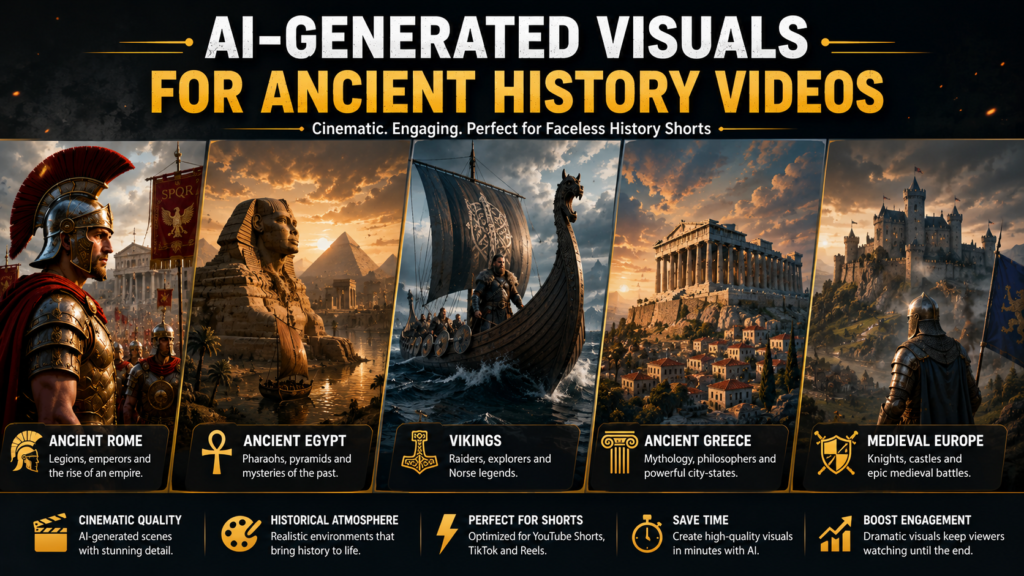
Many creators now use AI-generated visuals to recreate Roman battlefields, Viking ships during storms, or medieval kingdoms with surprisingly cinematic results.
Natural AI Voiceovers
Narration quality matters far more than many beginners realize.
Even visually impressive videos can lose viewer retention if the voice sounds robotic or emotionless. Historical storytelling works best when the narration feels dramatic, calm, mysterious, or emotionally engaging depending on the topic.
Platforms with high-quality AI voices usually offer:
- realistic narration;
- emotional tone control;
- multiple accents;
- voice customization;
- clearer pronunciation.
Automatic Subtitles
Most Shorts viewers watch videos on mobile devices, often without sound.
Because of this, subtitles are extremely important for retention and accessibility. Fast caption editing can save creators hours every week, especially when publishing consistently.
Vertical Video Optimization
Creators should also prioritize tools built specifically for vertical platforms like:
- YouTube Shorts;
- TikTok;
- Instagram Reels;
- Facebook Reels.
Mobile-first formatting is no longer optional for short-form growth.
Best Productivity Apps for Solo Podcast Creators
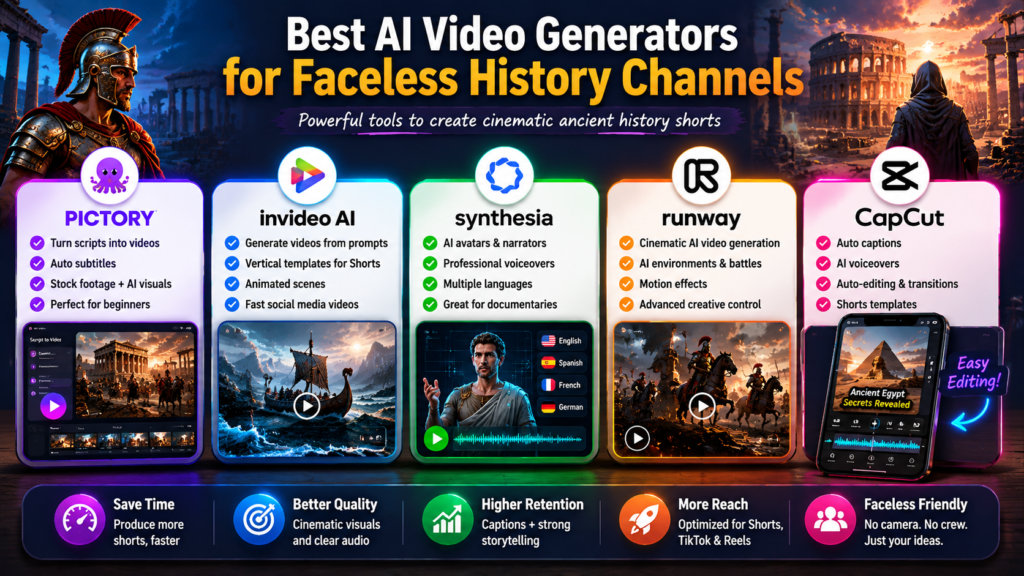
Best AI Video Generators for Historical Shorts
Pictory
Pictory is one of the easiest AI video tools for beginners who want to turn scripts into complete short-form videos quickly.
Many educational creators use it to combine narration, subtitles, stock footage, and AI-generated visuals into fast publishing workflows. Its interface is simple enough for solo creators who do not want to spend weeks learning advanced editing software.
Pictory works particularly well for:
- educational storytelling;
- quick Shorts production;
- automated subtitles;
- faceless content workflows.
InVideo AI
InVideo AI is useful for creators who want to generate fast social media videos directly from prompts.
Many creators use it to create short educational clips, historical narration videos, and cinematic storytelling content optimized for Shorts platforms.
The platform also includes templates designed specifically for vertical video formats, which helps simplify the editing process for beginners.
Synthesia
Synthesia is best known for AI avatars and professional narration tools.
Although many businesses use it for presentations and training videos, some creators use Synthesia for documentary-style historical explainers or educational narration content.
Its biggest strengths include:
- professional voiceovers;
- multilingual support;
- AI presenters;
- fast video production.
For creators experimenting with educational narration styles, it can be a surprisingly useful tool.
Runway
Runway has become increasingly popular among creators producing cinematic AI videos.
The platform offers advanced AI video generation features capable of creating dramatic scenes and visually immersive environments. Some creators use it to generate battle sequences, atmospheric historical shots, and stylized cinematic transitions.
The learning curve is steeper compared to beginner-friendly platforms, but the creative possibilities are impressive once creators become comfortable with the workflow.
CapCut AI Tools
Many small faceless creators rely heavily on CapCut because it simplifies subtitle editing, vertical formatting, pacing, and mobile-friendly publishing.
Its AI features include:
- automatic captions;
- AI voiceovers;
- background removal;
- auto-editing tools;
- Shorts templates.
Some creators combine AI-generated imagery from other platforms with CapCut editing workflows to speed up daily content production significantly.
AI Workflow Tools Helping Etsy Print on Demand Sellers Stay Organized
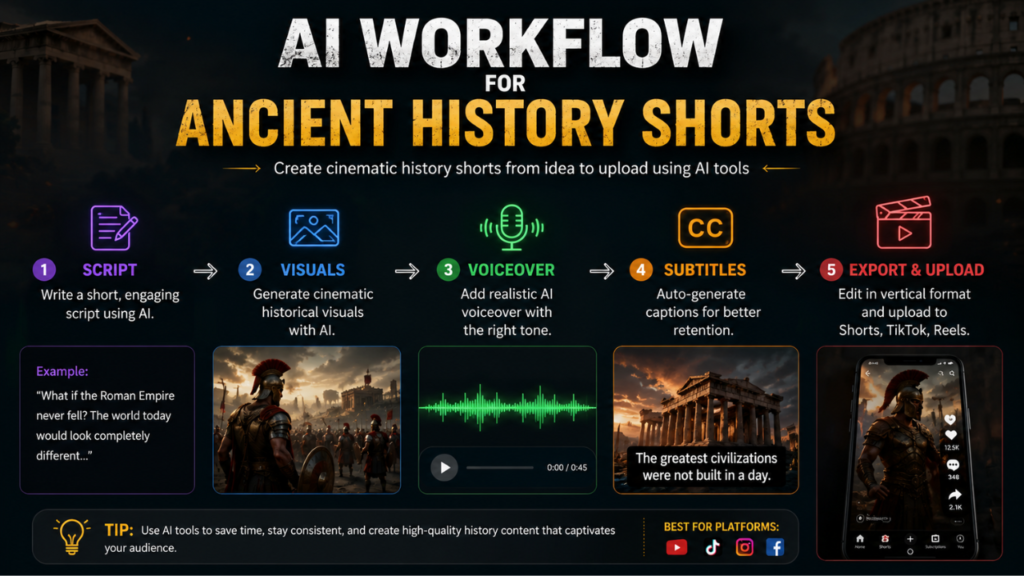
A Simple Workflow for Creating Faceless History Shorts
One reason this niche is growing so quickly is that creators can build repeatable workflows using AI tools.
A typical content system often looks like this:
Step 1: Research Curiosity-Driven Topics
Strong historical Shorts usually begin with emotionally engaging topics.
Creators often focus on:
- ancient wars;
- mythology;
- assassinations;
- survival stories;
- mysterious disappearances;
- legendary rulers;
- historical conspiracies.
Curiosity is one of the biggest drivers of watch time.
Step 2: Write a Fast-Paced Script
Most successful Shorts scripts are concise and highly structured.
A common format includes:
- a strong hook within the first few seconds;
- a surprising fact or dramatic question;
- a short explanation;
- an emotional or unexpected ending.
Many creators now use AI writing tools to brainstorm hooks and organize ideas before manually improving the final script.
Step 3: Generate Cinematic Visuals
Visual quality plays a huge role in retention.
Creators often generate scenes involving Roman soldiers, Viking invasions, medieval castles, or ancient temples to create a more immersive experience.
The goal is not historical perfection. The goal is visual storytelling that keeps viewers watching.
Step 4: Add Narration and Captions
Subtitles and narration are essential for mobile-first content.
Many creators underestimate how much captions improve retention rates, especially on TikTok and Shorts feeds where viewers scroll quickly.
Step 5: Optimize for Shorts Platforms
Before publishing, creators usually optimize for:
- 9:16 vertical format;
- fast pacing;
- strong opening frames;
- readable captions;
- mobile-friendly editing.
Consistency tends to matter more than perfection during the early growth stages of faceless channels.
Common Mistakes New Creators Make
One of the biggest mistakes beginners make is relying too heavily on automation.
AI tools can dramatically speed up production, but videos still need human storytelling decisions. Channels that publish generic scripts, robotic narration, or repetitive visuals often struggle to build long-term audience retention.
Other common mistakes include:
- slow intros;
- inaccurate historical information;
- weak hooks;
- overused stock footage;
- poor pacing;
- low-quality subtitles.
The creators growing fastest in this niche are usually the ones combining AI efficiency with curiosity-driven storytelling and emotionally engaging narratives.
The Future of AI Historical Content
Faceless educational channels continue growing across every major short-form platform.
As AI video tools improve, creators will be able to produce increasingly cinematic historical content with smaller budgets and faster workflows. However, the channels that succeed long-term will probably not be the ones relying entirely on automation.
The most successful creators will still be the ones who understand storytelling, pacing, emotional hooks, and audience psychology.
Ancient history remains one of the few educational niches where curiosity alone can still generate massive organic reach. For creators interested in faceless content, it offers a rare combination of entertainment, learning, mystery, and strong audience retention potential.
Some creators prefer fast publishing systems using simple editing tools, while others focus on highly cinematic documentary-style storytelling. Both approaches can work well when combined with consistency and engaging narratives.

ForgeCreatorAI Team writes about AI tools, content creation, digital workflows, and productivity systems for modern creators. Our goal is to simplify AI technology and help creators work smarter through practical tools and automation.