
How AI content repurposing for solo creators to turn one piece of original content into multiple useful assets without starting from scratch every time.
Creating content consistently is difficult when you are doing everything yourself.
A single YouTube video can take hours to research, script, record, edit, publish, and promote. Then, after all that work, the creator may move on to the next idea without realizing that the same video could become several additional pieces of content.
This is where AI content repurposing can make a major difference.
Instead of creating every post, short video, caption, or article from scratch, solo creators can use AI to break one original piece of content into multiple formats designed for different platforms.
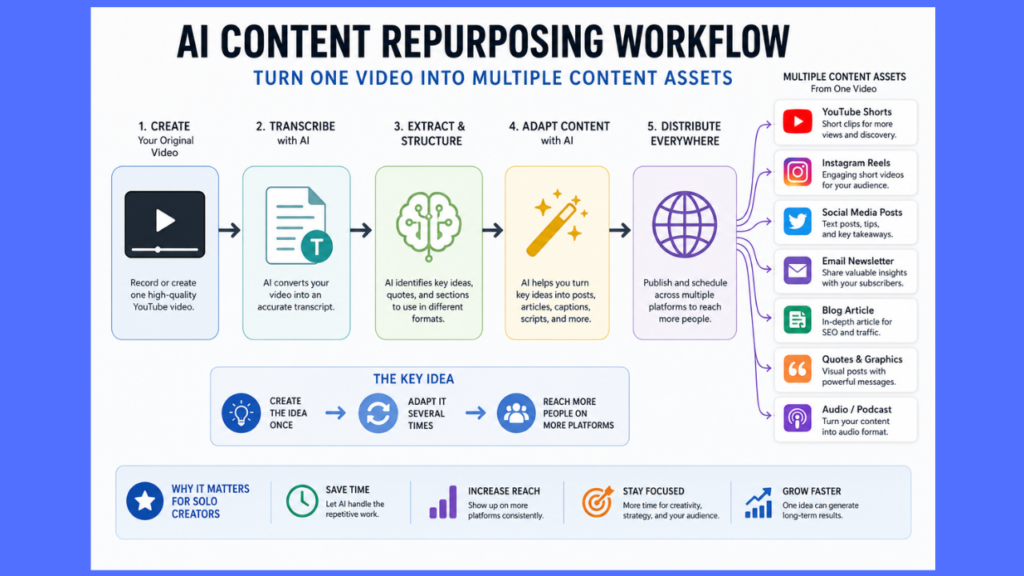
The important idea is simple:
Create the idea once. Adapt it several times.
AI does not need to replace the creator’s voice or creative decisions. It can handle much of the repetitive work involved in transforming existing content into new formats, giving solo creators more time to focus on storytelling, strategy, and their audience.
What Is AI Content Repurposing?
AI content repurposing is the process of using artificial intelligence to transform existing content into new formats.
For example, a 15-minute YouTube video could potentially become:
- Several YouTube Shorts
- Instagram Reels
- TikTok videos
- Social media posts
- A LinkedIn post
- An email newsletter
- A blog article
- Short quotes or hooks
- Video captions
- New content ideas
The goal is not to publish the exact same material everywhere.
The goal is to take the same core idea and adapt it to the way people consume content on each platform.
For a solo creator, this can turn one production session into an entire content workflow.
Why Repurposing Matters for Solo Creators
Large content teams can divide research, writing, editing, design, publishing, and social media management among several people.
Solo creators usually cannot.
One person may be responsible for the entire process.
That creates a common problem: the creator spends most of the available time producing new content and has very little time left for distribution.
AI can help compress the repetitive parts of this process.
Research from Adobe’s 2026 Creators’ Toolkit Report found that 93% of creators surveyed say creative AI helps them produce content faster, while 57% say AI-generated outputs still require moderate or extensive editing before publication.
That distinction matters.
AI can make production faster, but faster does not automatically mean better.
The creator still needs to decide what is worth publishing.
One Video Can Become an Entire Content System
Imagine that a solo YouTuber records a video called:
“How I Use AI to Plan My Weekly Content.”
Instead of treating that video as a single finished product, the creator can treat it as the source material for several pieces of content.
The original video
The full YouTube video explains the complete workflow.
Short-form videos
The strongest moments can become short videos.
For example:
- “The biggest mistake I made when planning content”
- “My 3-step AI content workflow”
- “Why most creators waste time brainstorming”
Each short focuses on one idea rather than attempting to summarize the entire video.
Social posts
The same ideas can be converted into short text posts.
A lesson from the video can become a question, observation, checklist, or personal story.
Newsletter
The creator can expand one of the video’s most useful ideas into an email for subscribers.
Blog article
The complete subject can become a more detailed written guide that targets people searching for the topic.
The content is not being duplicated blindly.
It is being reframed for different audiences and formats.
AI Content Repurposing for Solo Creators Works
A simple workflow can look like this:
Record → Transcribe → Extract → Adapt → Review → Publish
1. Record the original content
Start with something substantial.
For many creators, this might be a YouTube video, podcast episode, tutorial, interview, or livestream.
The better the original material, the more useful the repurposing process becomes.
2. Transcribe the content
The recording can be converted into text.
This gives AI access to the actual words, ideas, examples, and explanations contained in the original production.
Transcription also makes it easier to search through a long recording.
3. Extract the strongest ideas
This is where AI becomes particularly useful.
Instead of asking:
“Turn this video into social posts.”
A better approach is to ask AI to identify:
- Strong opinions
- Useful lessons
- Surprising statements
- Questions
- Practical tips
- Stories
- Examples
- Potential short-video moments
This creates a content inventory before anything is rewritten.
4. Adapt each idea
Now the ideas can be transformed into platform-specific formats.
A useful YouTube explanation might become a 30-second Reel.
A story might become a social post.
A detailed explanation might become a blog article.
A controversial opinion might become a discussion prompt.
The important principle is:
Same idea, different format.
5. Review everything
This step should not be skipped.
AI may remove important context, change the tone, exaggerate a statement, or produce something that sounds generic.
Solo creators should review the content for accuracy, personality, and relevance before publishing.
This is particularly important because creators themselves continue to place high value on human judgment. Adobe’s 2026 research found that 81% of surveyed creators believe human judgment remains essential to creative taste.
6. Publish strategically
Not every piece needs to be published on every platform.
A creator can choose the formats that make the most sense for the audience.
The objective is not maximum volume.
It is getting more value from the original creative work.
AI Tools That Can Help With Repurposing
Different tools can support different parts of the workflow.
Tools such as OpusClip can help identify and create short-form clips from longer videos.
Descript can make transcript-based editing and content transformation easier.
Castmagic can turn recordings into written content and marketing assets.
Repurpose.io focuses on distributing content across multiple platforms.
Other tools can assist with video editing, captions, writing, thumbnails, and other parts of the production process.
The important point is that a creator does not necessarily need a large collection of AI tools.
The strongest workflow may come from combining a small number of tools effectively rather than constantly switching between platforms.
Recent creator research also shows that creators increasingly use several AI systems rather than relying on a single tool. Kit’s 2026 survey of 550 creators found that ChatGPT was used by 73.3% of respondents and Claude by 69.8%, while 57.3% said they use AI tools every day.
What AI Should Not Do
There is a temptation to automate everything.
That can create another problem.
If every piece of content is automatically generated from the same source, the creator’s channels can quickly become repetitive.
AI should help with the mechanical work.
The creator should remain responsible for:
- The central idea
- Personal opinions
- Storytelling
- Brand voice
- Final editing
- Audience understanding
- What gets published
This becomes even more important as AI-generated content becomes increasingly common.
When everyone can produce more content, simply producing more is not necessarily an advantage.
The creator’s perspective becomes more important.
Adobe’s 2026 research found that 81% of creators believe human judgment remains essential to creative taste, while 85% believe their AI-assisted work still reflects their unique voice.
Common AI Content Repurposing Mistakes
Publishing identical content everywhere
A TikTok, Instagram Reel, LinkedIn post, and YouTube Short should not necessarily have identical wording or structure.
Each platform has different expectations.
Creating too much content
Repurposing is supposed to save time.
If it creates an endless publishing schedule that the creator cannot maintain, the system has failed.
Removing the creator’s personality
AI can make content sound polished but generic.
Personal experiences, opinions, humor, and specific examples are often what make the content worth following.
Skipping the review stage
AI-generated material should be checked before publication.
Small inaccuracies or awkward wording can damage credibility.
Focusing on quantity instead of usefulness
The goal is not to turn one video into 50 pieces of mediocre content.
The goal is to discover the best ideas inside the original content and give them new opportunities to reach people.
A Practical Repurposing System for One Person
A solo creator can keep the process surprisingly simple.
Start with one substantial piece of content each week.
For example:
Monday: Research and record one long-form video.
Tuesday: Transcribe the video and identify the strongest ideas.
Wednesday: Create short-form clips and social posts.
Thursday: Turn one section into a detailed article or newsletter.
Friday: Review, schedule, and organize the week’s content.
The exact schedule can change, but the principle remains the same.
Instead of asking:
“What should I create today?”
the creator can ask:
“What else can I create from what I already made?”
That small change can completely alter the workflow.
The Real Advantage of AI Content Repurposing
The biggest benefit is not that AI creates more content.
It is that AI can help a solo creator extract more value from the work they have already done.
A carefully researched video contains ideas, explanations, stories, questions, examples, and opinions.
Without repurposing, much of that material may only be seen once.
With a structured workflow, the same creative investment can reach people through several different formats.
That is especially valuable for solo creators who do not have a writer, editor, social media manager, and content strategist working beside them.
AI can help fill some of those workflow gaps.
But the creator should remain the person deciding what is worth saying.
The most sustainable approach is not:
AI creates everything.
It is:
Creator creates the idea. AI helps multiply it. Creator decides what deserves to be published.
That is what makes AI content repurposing for solo creators: not replacing the creative process, but making the original work go further.

ForgeCreatorAI Team writes about AI tools, content creation, digital workflows, and productivity systems for modern creators. Our goal is to simplify AI technology and help creators work smarter through practical tools and automation.