
AI voice tools for faceless documentary YouTube channels are helping creators produce realistic narration, save time, and streamline documentary production workflows.
Some creators build entire audiences without ever appearing on camera. Instead of relying on personal branding, they focus on storytelling, narration, editing, visuals, historical research, and emotional pacing to keep viewers engaged.
What many people do not realize is how much work exists behind these videos.
A single documentary upload may require hours of scriptwriting, research organization, voice recording, editing, sound design, thumbnail creation, and SEO optimization before the video is finally published.
For smaller creators managing everything alone, narration often becomes one of the biggest production challenges.
Recording voiceovers manually can be exhausting, especially for creators publishing consistently or working in multiple languages. This is one reason AI voice tools are becoming increasingly common inside faceless YouTube workflows.
Not because creators want videos to sound robotic, but because modern AI narration tools are becoming surprisingly realistic and much more efficient for independent creators trying to scale content production.
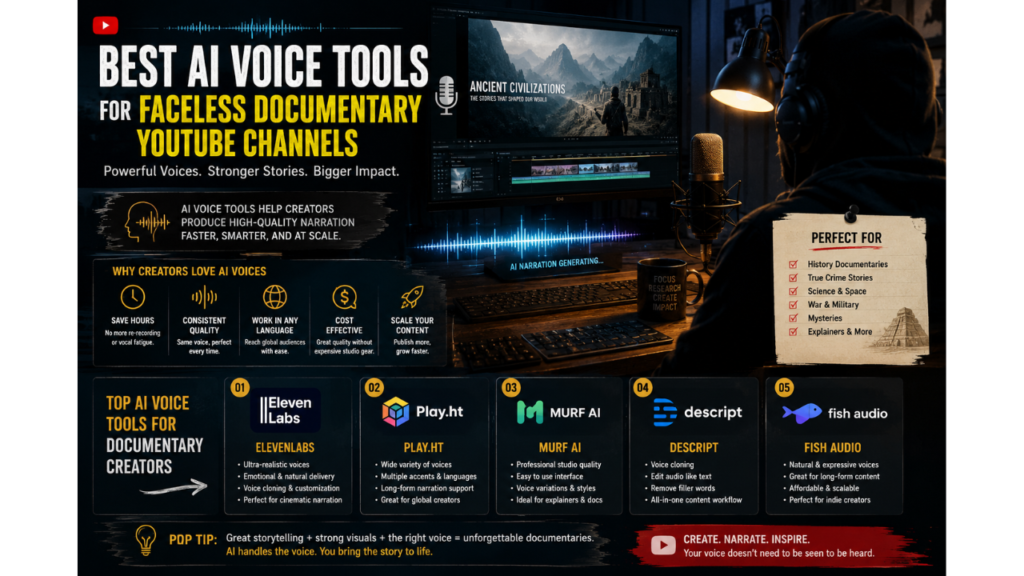
Why Documentary Channels Depend So Much on Narration
Unlike fast-paced entertainment videos, documentary channels rely heavily on atmosphere and storytelling.
The narration becomes the emotional thread connecting every scene together.
A weak voice can instantly reduce viewer retention, while strong narration can make even simple visuals feel cinematic and immersive.
This is especially important for content involving:
- Ancient history
- Mystery documentaries
- True crime
- Science explainers
- Space content
- War history
- Political analysis
- Technology documentaries
- Philosophy channels
In these formats, the voice often becomes part of the channel identity itself.
Many creators eventually realize that narration quality influences audience engagement almost as much as editing or research quality.
That pressure has pushed many smaller YouTubers to explore AI voice technology as part of their production workflow.
AI Voice Tools Have Improved Dramatically
Several years ago, AI-generated voices sounded unnatural and emotionally flat.
Most viewers could immediately recognize synthetic narration because the pacing felt awkward and robotic.
That situation has changed significantly.
Modern AI voice platforms now offer:
- Natural pauses
- Emotional tone variation
- Human-like pacing
- Multiple accents
- Language flexibility
- Voice customization
- Cinematic narration styles
Some AI voices are now realistic enough that casual viewers cannot easily distinguish them from real recordings.
For documentary creators, this opens new creative possibilities.
Channels can maintain consistent narration quality without requiring expensive recording equipment or professional voice actors.
Why Smaller Creators Benefit the Most
Large YouTube channels often hire professional narrators, editors, and production teams.
Independent creators rarely have those resources.
A smaller documentary creator may spend days researching historical events, writing scripts, collecting visuals, editing footage, and optimizing metadata entirely alone.
Recording narration then becomes another time-consuming layer added on top of an already demanding workflow.
AI voice tools help reduce some of this pressure.
Instead of spending hours re-recording lines because of microphone issues, background noise, or vocal fatigue, creators can focus more energy on storytelling and editing.
This becomes especially valuable for creators publishing long-form documentary content consistently.
For many channels, AI narration is not replacing creativity.
It is reducing production friction.
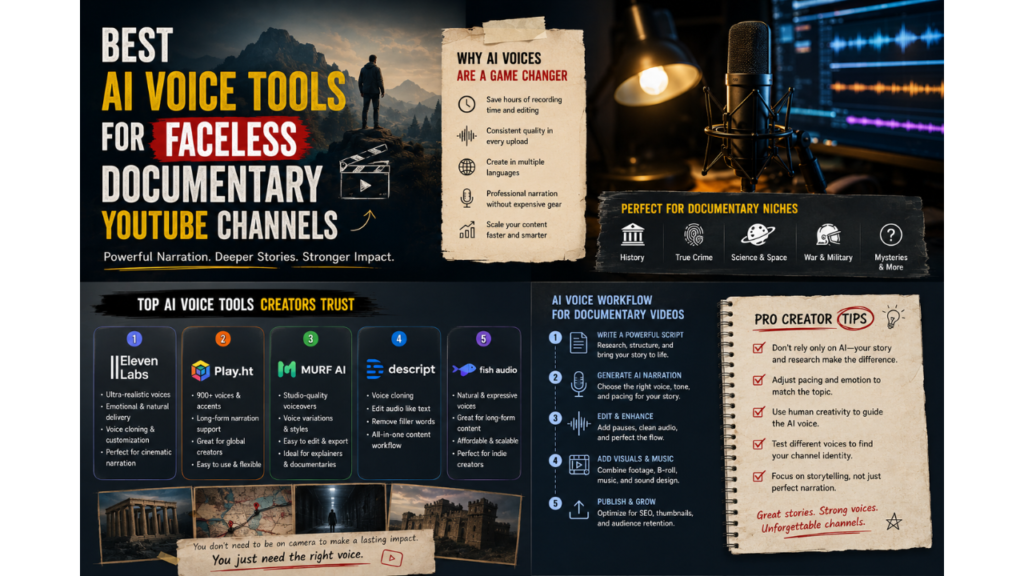
The Best AI Voice Tools for Documentary Channels
ElevenLabs
ElevenLabs has become one of the most popular AI voice platforms among YouTube creators.
Its voices sound highly realistic and work particularly well for documentary narration because of their emotional tone and natural pacing.
Creators frequently use ElevenLabs for:
- Historical documentaries
- Mystery storytelling
- Educational narration
- Space videos
- Cinematic YouTube essays
The platform also allows creators to fine-tune delivery styles and voice consistency.
Play.ht
Play.ht is widely used for creators needing flexible voice libraries and multiple narration styles.
Documentary creators often appreciate its:
- Wide selection of voices
- Accent options
- Commercial usage support
- Long-form narration capability
It works especially well for creators producing educational or informational content regularly.
Murf AI
Murf AI focuses heavily on professional-quality narration.
Many creators use it for:
- Explainer videos
- Documentary voiceovers
- Educational presentations
- Business storytelling
Its interface is beginner-friendly, which helps newer creators start quickly without complicated audio workflows.
Descript
Descript combines voice generation with editing tools, making it useful for creators who want narration and workflow management inside one platform.
Some documentary creators use it for:
- Voice cloning
- Script editing
- Audio cleanup
- Podcast narration
- Video production workflows
Its editing system feels especially practical for creators handling multiple projects simultaneously.
Human Storytelling Still Matters More Than AI
Even with advanced narration technology, successful documentary channels still depend heavily on human creativity.
Viewers stay engaged because of:
- Story structure
- Emotional pacing
- Curiosity
- Editing rhythm
- Research depth
- Narrative tension
- Unique perspective
AI may deliver the voice, but it does not automatically create compelling storytelling.
A documentary about forgotten civilizations still needs strong writing.
A mystery channel still requires suspense.
A history video still depends on research and structure.
The creators growing sustainable audiences are usually the ones using AI as a support tool rather than a replacement for creativity itself.
Some Creators Still Avoid AI Voices
Not every documentary creator feels comfortable using AI narration.
Some worry that AI-generated voices may eventually make YouTube content feel repetitive or emotionally empty.
Others prefer authentic human imperfections inside narration because they create stronger emotional connection.
These concerns are understandable.
Poorly used AI narration often sounds lifeless when creators rely entirely on automation without adjusting pacing, script flow, or emotional delivery.
Viewers usually recognize quickly when narration feels disconnected from the story being told.
This is why many successful creators still spend significant time refining scripts manually before generating voiceovers.
Some even combine AI narration with human editing techniques to create more natural delivery.
The technology may handle the voice itself, but the emotional direction still depends heavily on the creator behind the project.
Consistency Becomes Easier With AI Workflows
One major challenge for faceless documentary channels is maintaining a consistent upload schedule.
Long-form content takes time.
Research-heavy videos can require days of preparation before recording even begins.
AI voice tools help simplify one of the most repetitive stages of production.
Instead of delaying uploads because narration recording becomes overwhelming, creators can maintain more organized publishing systems.
Some channels now produce:
- Weekly documentaries
- Multi-language uploads
- YouTube Shorts adaptations
- Educational mini-series
- Repurposed content for TikTok and Instagram
This level of consistency becomes much more realistic when repetitive production tasks are streamlined.
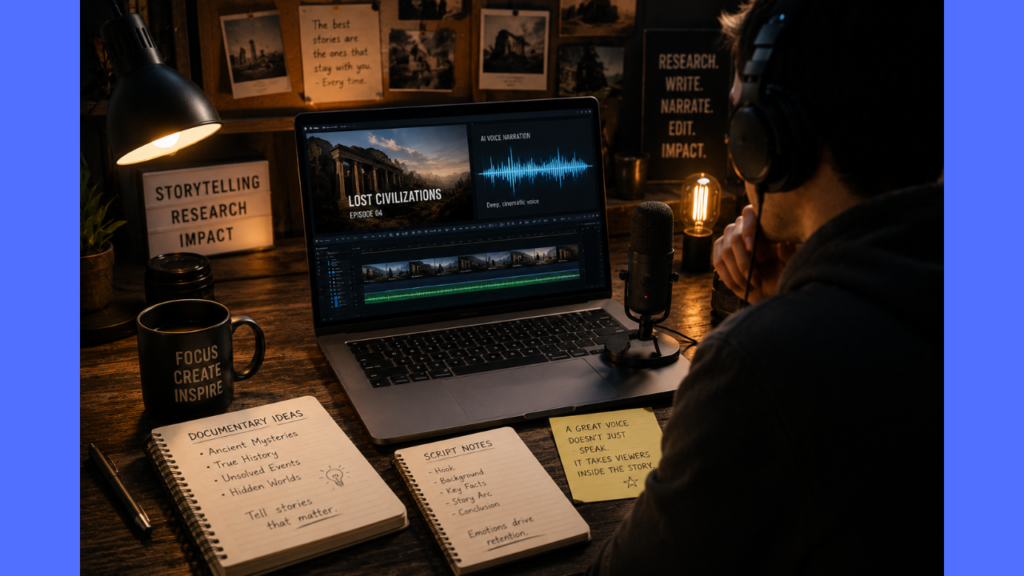
Documentary Content Will Continue Evolving Alongside AI
AI voice technology will likely become increasingly common across YouTube over the next several years, especially among independent creators trying to compete with larger production teams.
But even as these tools evolve, the documentary channels that stand out long-term will probably continue sharing the same core qualities: authenticity, storytelling depth, emotional pacing, and genuine curiosity.
Viewers rarely subscribe because a voice sounds perfect.
They subscribe because a creator makes information feel meaningful, immersive, and emotionally engaging.
AI narration may continue transforming production workflows, but the heart of documentary storytelling will still depend on human imagination, perspective, and the ability to make viewers feel connected to the story unfolding on screen.
And perhaps that balance between technology and human creativity is exactly what makes this new generation of faceless documentary channels so fascinating to watch.

ForgeCreatorAI Team writes about AI tools, content creation, digital workflows, and productivity systems for modern creators. Our goal is to simplify AI technology and help creators work smarter through practical tools and automation.