
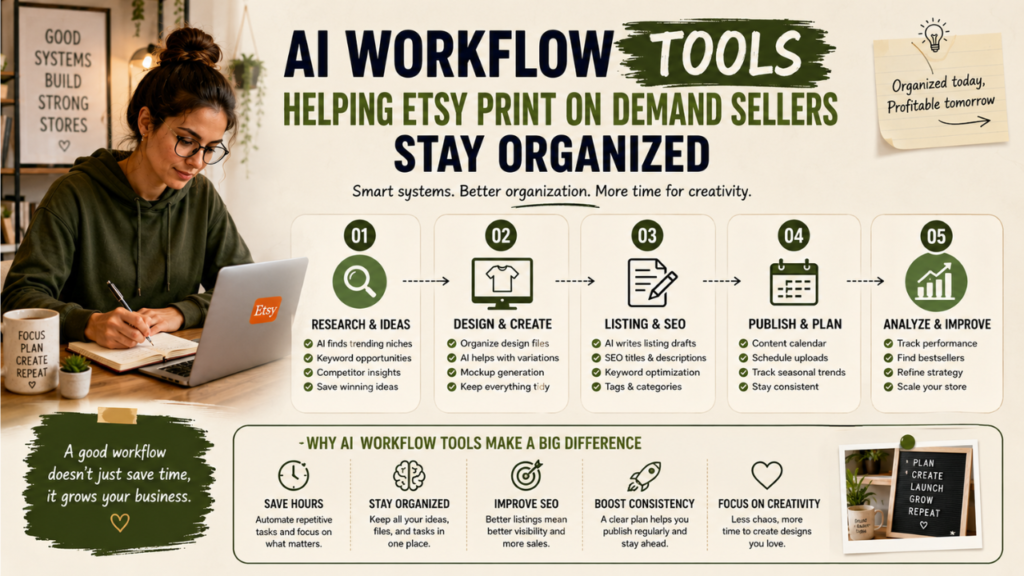
AI workflow tools helping Etsy print on demand sellers stay organized are making it easier to manage products, SEO, content planning, and daily business tasks.
Many people imagine sellers uploading a few designs, adding product titles, and waiting for sales to arrive automatically. But creators who actually work inside the print-on-demand world know the reality is far more demanding.
Behind every Etsy store, there is usually a constant cycle of research, design organization, product uploads, keyword optimization, mockup creation, customer communication, trend analysis, and content planning happening quietly in the background.
And for independent sellers handling everything alone, the workload can become overwhelming surprisingly fast.
This is one reason AI workflow tools are becoming increasingly popular among Etsy print-on-demand creators. Not because AI magically runs a successful store automatically, but because better organization helps sellers manage repetitive tasks more efficiently while protecting creative energy.
For many creators, AI workflow systems are becoming less about automation alone and more about maintaining consistency without burnout.
The Print-on-Demand Business Model Requires Constant Organization
Unlike traditional ecommerce stores, print-on-demand businesses often move very quickly.
New trends appear almost daily.
Holiday designs suddenly explode in popularity.
Niche markets change rapidly.
Keywords evolve constantly.
Sellers may upload dozens or even hundreds of products every month while trying to keep listings optimized and organized.
A typical Etsy print-on-demand creator may simultaneously manage:
- Product descriptions
- SEO keywords
- Mockup files
- Design folders
- Trend research
- Social media promotion
- Customer messages
- Product variants
- Seasonal launches
- Publishing schedules
Without systems in place, information quickly becomes scattered across multiple platforms and folders.
Many sellers eventually realize they spend almost as much time organizing work as actually creating products.
That is where workflow tools begin making a major difference.
AI Workflow Tools Are Reducing Repetitive Work
One common misunderstanding is the idea that successful Etsy stores are now completely automated by AI.
In reality, most experienced sellers use AI much more strategically.
The technology often supports organization rather than replacing creativity entirely.
Some sellers use AI workflow tools to help:
- Organize product ideas
- Generate listing drafts
- Structure SEO descriptions
- Track niche research
- Manage publishing calendars
- Create content systems
- Store keyword databases
- Plan seasonal launches
Many creators are also exploring AI writing systems similar to those used by independent bloggers and content creators.
Instead of constantly restarting from scratch, creators build repeatable systems that reduce mental overload over time.
For independent sellers juggling multiple responsibilities, that extra organization can significantly improve productivity.
Smaller Etsy Sellers Often Benefit the Most
Large ecommerce companies usually have teams managing operations.
Independent Etsy creators rarely have that advantage.
A single seller may spend the morning designing products, the afternoon editing mockups, and the evening answering customer questions while researching new trends for future listings.
Over time, this constant multitasking becomes mentally exhausting.
AI workflow tools help smaller creators simplify some of this pressure by creating more structured systems around content production and store management.
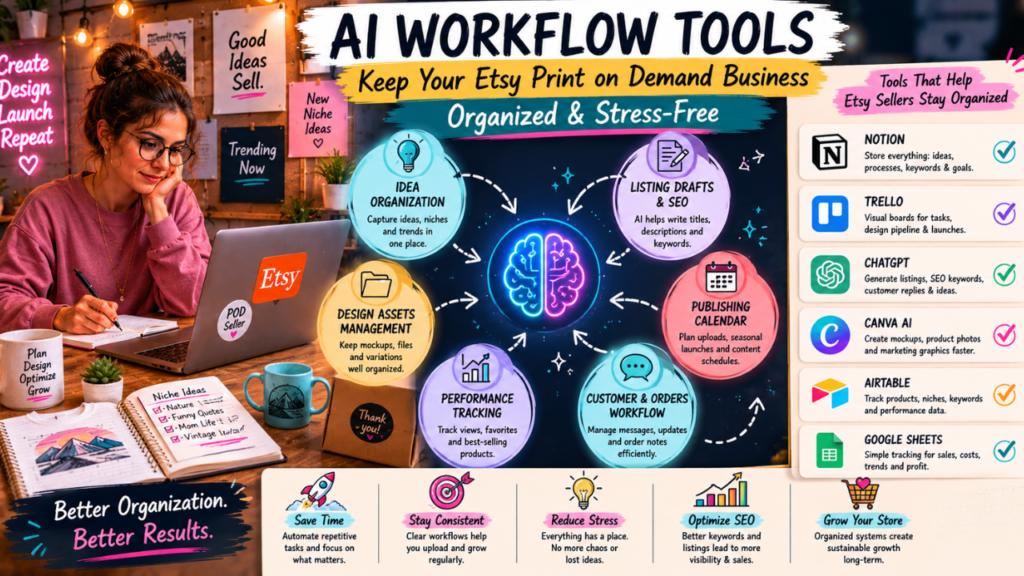
Many sellers now use platforms like:
- Notion
- Trello
- ClickUp
- Airtable
- ChatGPT
- Canva AI tools
These systems help creators centralize information instead of constantly switching between disconnected apps and spreadsheets.
Similar organization methods are now being used by YouTube script writers managing large volumes of content ideas and production planning.
For many Etsy sellers, better organization leads to more consistent product uploads and fewer abandoned ideas.
SEO Organization Has Become Essential on Etsy
Years ago, many Etsy stores could grow with minimal optimization.
Today, competition is far more intense.
Thousands of sellers may target the same niches simultaneously, especially inside popular categories like:
- T-shirts
- Mugs
- Stickers
- Printable art
- Phone cases
- Digital planners
- Wall decor
This has made SEO organization extremely important.
Many AI workflow systems now help sellers track:
- High-performing keywords
- Product categories
- Seasonal search trends
- Competitor observations
- Listing performance
Instead of randomly uploading products, creators can build more intentional strategies around searchable niches and buyer behavior.
For smaller stores trying to gain visibility, this type of organization often becomes a competitive advantage.
Human Creativity Still Drives Successful Etsy Stores
Even with advanced workflow systems, successful Etsy businesses still depend heavily on creativity and originality.
AI can help organize information, but it cannot fully replace:
- Personal style
- Trend intuition
- Emotional branding
- Design taste
- Audience connection
- Creative storytelling
Buyers usually connect more strongly with stores that feel authentic and visually consistent.
A generic store filled with repetitive AI-generated designs often struggles to build long-term loyalty.
This is why many successful creators use AI carefully rather than relying entirely on automation.
The strongest Etsy brands still feel human behind the scenes.
Burnout Is Becoming Common Among Independent Sellers
One topic many Etsy creators rarely discuss openly is creator exhaustion.
Managing a print-on-demand business alone often creates pressure to constantly produce more products, follow new trends, and maintain daily consistency.
Many sellers eventually experience periods where:
- Motivation drops
- Product ideas feel repetitive
- Organization becomes chaotic
- Upload schedules collapse
- Creative fatigue increases
AI workflow systems cannot eliminate these challenges completely.
However, they can reduce some of the repetitive mental load that contributes to burnout over time.
For many creators, simply having cleaner organization systems creates more mental clarity and allows creativity to feel enjoyable again.
Productivity systems are becoming essential across nearly every type of independent creator business.
Why Workflow Systems Matter More Than Speed
Many new sellers focus heavily on uploading products as fast as possible.
But long-term success usually depends more on consistency and organization than pure speed.
A smaller store with clear systems often performs better over time than a chaotic store constantly chasing trends without structure.
Workflow tools help creators:
- Maintain publishing consistency
- Organize design assets
- Track successful niches
- Improve SEO routines
- Plan seasonal content
- Reduce repetitive decision-making
This creates a more sustainable business environment, especially for creators building stores independently.

The Future of Etsy Creation Will Likely Include AI Assistance
AI tools will probably become increasingly common across Etsy and print-on-demand businesses over the next several years.
Tasks that once required large teams can now be managed more efficiently by individuals using smarter workflow systems.
But even as AI continues evolving, the Etsy stores that stand out long-term will likely continue sharing the same core qualities: originality, consistency, branding, and authentic creativity.
Customers rarely favorite a store simply because it uses automation effectively.
They connect with shops that feel intentional, visually cohesive, and genuinely creative.
AI workflow tools may continue improving organization, productivity, and efficiency, but the emotional connection between creators and buyers will still depend largely on human creativity and personal vision.
And perhaps that balance between technology and creativity is exactly what modern independent sellers are learning to master one organized workflow at a time.

ForgeCreatorAI Team writes about AI tools, content creation, digital workflows, and productivity systems for modern creators. Our goal is to simplify AI technology and help creators work smarter through practical tools and automation.